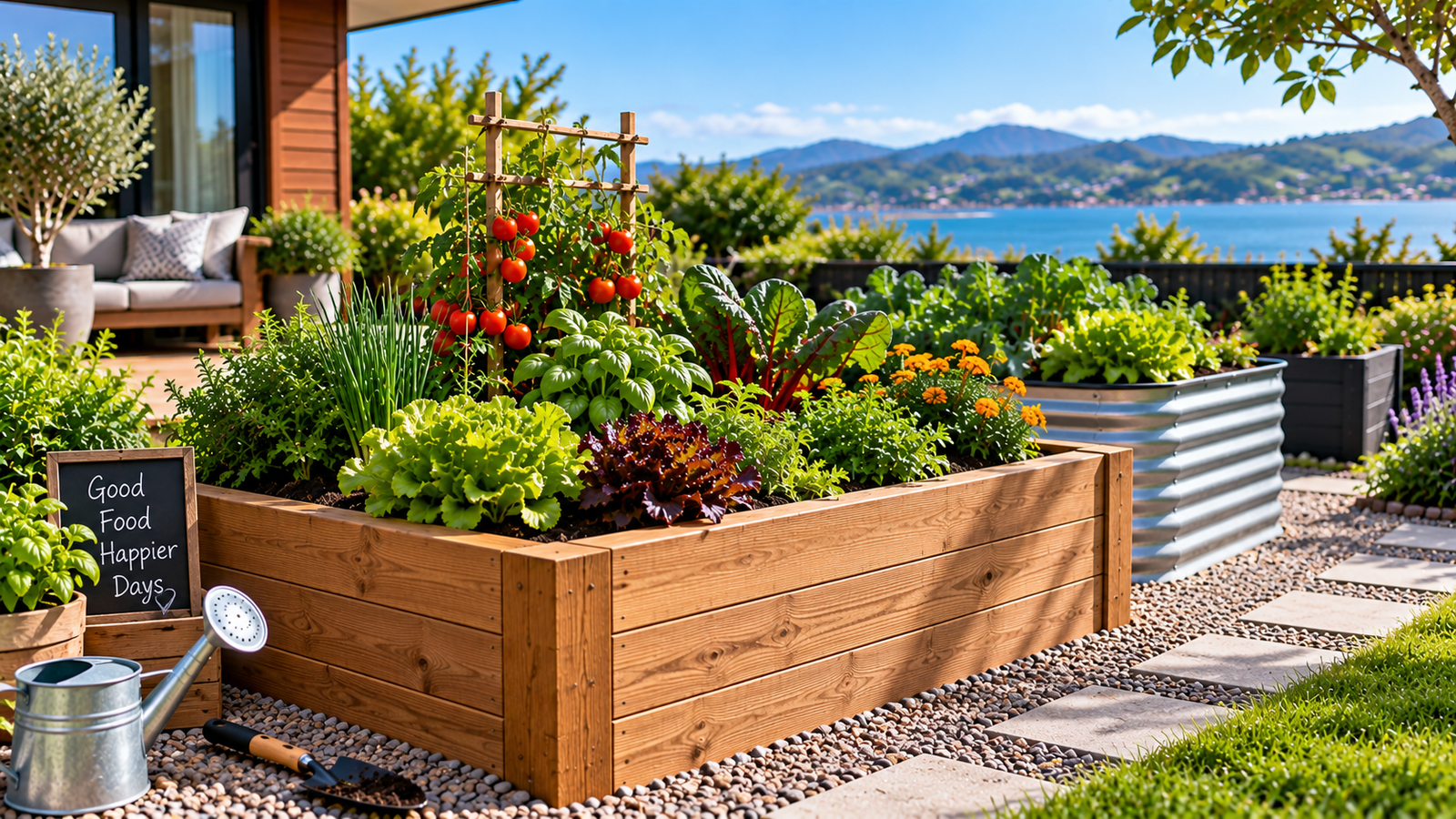
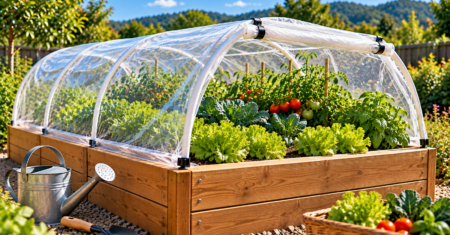
Raised garden beds are one of the easiest ways to create a productive growing space when the ground below is compacted, poorly drained, root-filled or simply inconvenient to work. In New Zealand, they are used everywhere from compact urban courtyards to large vegetable gardens — but the best bed is not necessarily the tallest, most expensive or most heavily built.
For most Kiwi home gardens, a raised bed around 0.8–1.0 m wide is easy to reach from both sides. A growing depth of roughly 30 cm or more gives many vegetables a useful root zone when the ground underneath is poor, while shallower beds can work where roots can continue into good loosened soil below. Timber is warm and easy to customise, coated or galvanised steel is low-maintenance, and modular kits are the quickest option. Prioritise sunlight, drainage, reachable width and good growing media before worrying about decorative extras.
What is a raised garden bed?
A raised garden bed is a contained growing area built above the surrounding ground level. The sides may be made from timber, steel, masonry, plastic/composite materials or another durable border, and the interior is filled or improved with soil and organic matter.
Raised beds are different from ordinary pots because they are usually larger and, in many designs, open to the soil underneath. That means plant roots may be able to move beyond the imported growing mix into the ground below. This distinction matters when deciding how deep the bed really needs to be.
They can be used for vegetables, herbs, berries, flowers and small shrubs. For edible gardens, the big advantage is control: instead of trying to correct an entire backyard’s soil, you can concentrate your effort and growing media in a defined area.
Why raised garden beds work well in New Zealand
New Zealand gardens vary enormously in soil, rainfall, wind exposure and frost risk, so there is no single raised-bed design that suits every region. Even so, raised beds solve several common problems particularly well.
Better control of soil
You choose the growing medium rather than relying entirely on compacted, clay-heavy or low-quality existing soil.
Improved drainage
A correctly built open-bottom bed can shed excess water more readily than a low, compacted patch of ground.
Easier access
Higher beds reduce bending and can be designed around standing, seated or limited-mobility gardening.
Defined growing space
Paths, mulch and lawn stay separate from the productive soil, making the garden easier to organise and maintain.
Planting Season, a New Zealand gardening publication, also notes that raised beds can be particularly useful where ground soil is heavy clay, poorly drained or crowded with tree roots, and that the contained soil can warm earlier in spring. Those benefits are useful, but raised beds are not automatically “better” than in-ground gardens: they cost more to establish and can dry out faster in exposed or hot locations.
If you already have deep, fertile, free-draining soil and comfortable access, an in-ground garden may be cheaper and equally productive. Raised beds make the most sense when they solve a real problem: soil quality, drainage, accessibility, layout or space.
Best raised garden bed materials in NZ
The material affects price, appearance, maintenance and how easily the bed can be changed later. There is no universal winner, so start with your site and priorities.
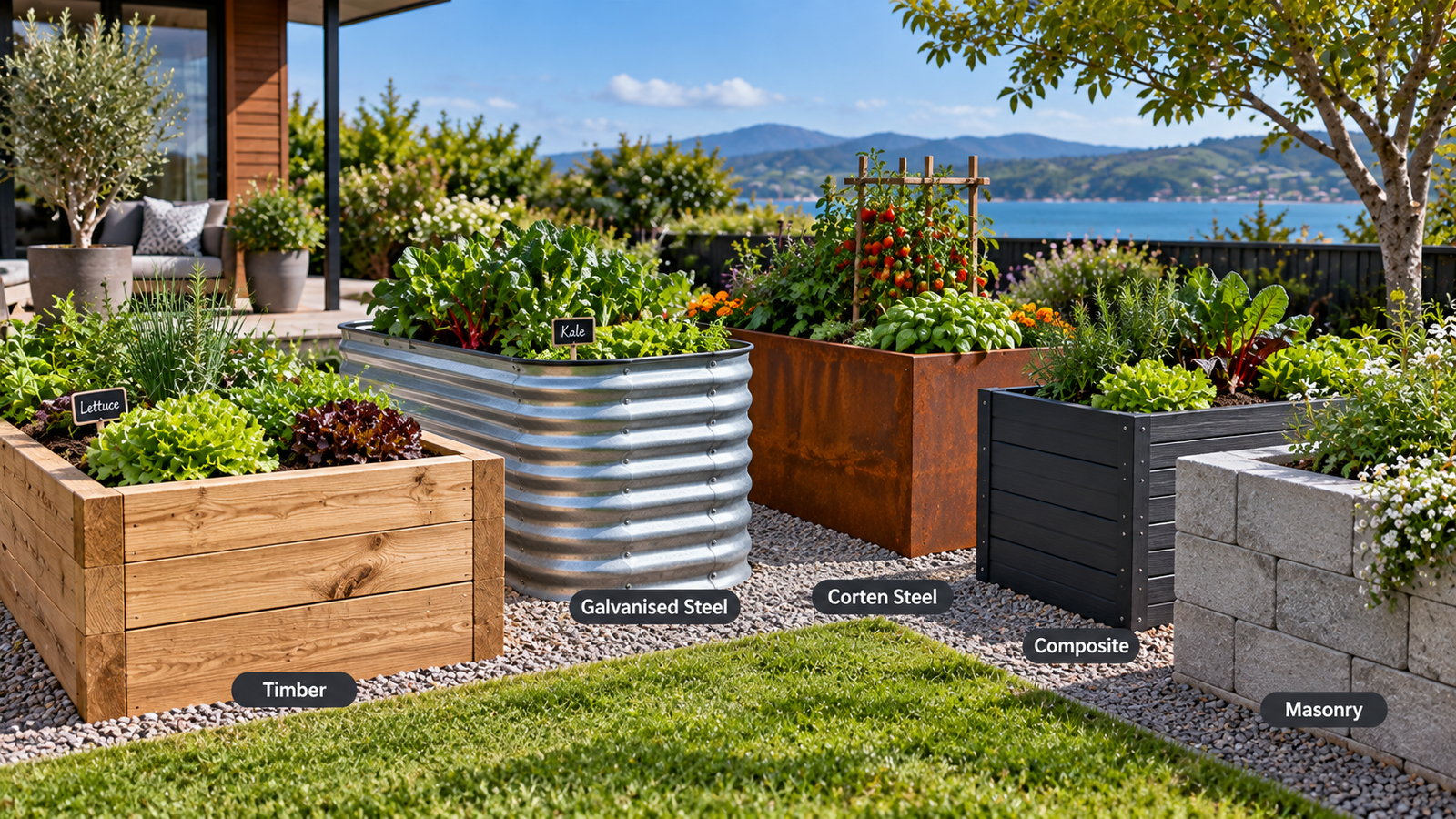
| Material | Best for | Advantages | Watch for |
|---|---|---|---|
| Timber | DIY builds, traditional gardens, custom dimensions | Easy to cut, modify and repair; visually warm | Ground-contact durability, treatment type, eventual decay |
| Galvanised/coated steel | Low-maintenance gardens, modular layouts | Thin walls maximise growing area; kits assemble quickly; durable finish | Sharp unfinished edges, denting on lightweight products, heat exposure |
| Corten/weathering steel | Modern landscapes and premium design | Strong architectural appearance; develops a protective patina | Higher cost; early weathering can produce rust-coloured runoff on nearby porous surfaces |
| Composite/plastic | Low-maintenance or portable systems | No timber rot; often lightweight and modular | Quality and UV durability vary; cheap systems may flex under soil pressure |
| Brick/block/stone | Permanent landscape features | Long life, strong visual structure, good for wide coping/seating edges | More base preparation, labour and cost; difficult to relocate |
Timber raised garden beds
Timber remains one of the most practical materials for DIY raised beds because it is easy to size around a real garden rather than forcing the garden to fit a prefabricated kit. Sleepers and boards can also be replaced individually if one section eventually deteriorates.
For treated timber that is exposed to direct ground contact, New Zealand treatment classifications matter. Check the treatment stamp and intended use of the actual product rather than assuming that all outdoor timber has the same durability.
Steel raised garden beds
Steel kits dominate many current NZ retail ranges because they are quick to assemble, relatively slim and available in numerous shapes. Bunnings NZ currently lists models from compact, low-cost planters through to tall modular Birdies beds, while Trade Tested carries galvanised, powder-coated and Corten options.
When comparing steel beds, look beyond colour. Check the thickness of the panels, whether the upper edge is rolled or protected, the bracing system on long sides, the coating or galvanising system, fastener quality and the warranty.
Composite and plastic beds
These can make sense when portability and rot resistance matter. The trade-off is that the walls need enough stiffness to resist outward soil pressure. Long, deep beds place far more load on their sidewalls than a small herb planter, so very light panels and weak corner connectors deserve scrutiny.
Is treated timber safe for raised vegetable beds?
This deserves more nuance than a simple “yes” or “no”. The New Zealand Environmental Protection Authority says the risks associated with using treated timber for planters and raised vegetable beds are negligible, while also noting that treatment chemicals such as CCA can leach compounds into soil over a long period.
The EPA explains that modern treatment standards require preservatives to be fixed into the timber before sale. For gardeners who still want to reduce potential exposure further, it suggests keeping plants a few centimetres away from treated timber or lining the inside of the planter. It also names harder untreated timbers such as macrocarpa, Douglas fir and Lawson cypress as alternatives.
Wear appropriate eye and respiratory protection, work in a well-ventilated outdoor area, clean up sawdust and offcuts, and do not burn treated timber or put its sawdust into compost or garden mulch. Follow the EPA guidance and the safety instructions for your tools and timber product.
This means there are several reasonable approaches for a food garden: use correctly treated timber and follow EPA precautions, line the walls, or choose a suitable untreated durable timber or non-timber material. The right choice depends on your budget, maintenance expectations and personal preference.
What is the best size for a raised garden bed?
Width: design for reach
Width is more important than many buyers realise. A bed that is too wide forces you to step or lean heavily onto the growing soil, which defeats one of the advantages of a raised bed.
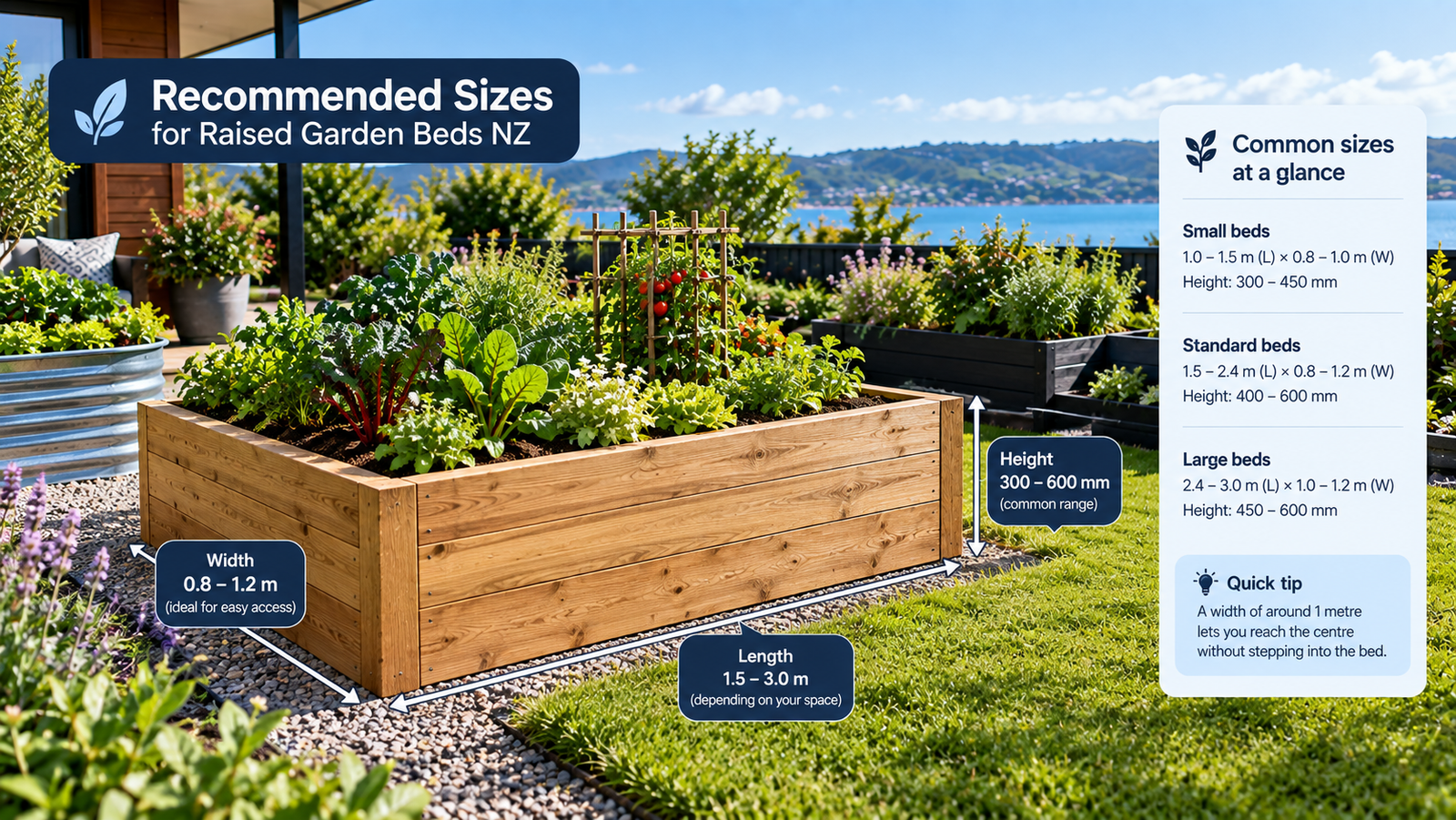
A practical target for a bed accessible from both sides is around 0.8–1.0 m wide. Planting Season recommends about one metre for easy access to the centre. If the bed can only be reached from one side — for example, against a fence — make it narrower so you can comfortably reach the back without climbing into it.
Length: almost entirely site-dependent
Length is flexible. A 1.2 m bed can be perfect for a courtyard; a 2.4 m or longer bed may suit a larger vegetable garden. Long beds need stronger sidewall support because wet soil exerts considerable outward pressure. Timber may need intermediate stakes or posts, while modular steel systems may use cross-bracing.
Height and growing depth
There is no universal “correct” raised-bed depth. Daltons’ New Zealand guidance is useful here: if crops can root into suitable loosened soil underneath, roughly 15–20 cm of added vegetable mix can be enough in some situations. If the soil below is unsuitable, Daltons recommends adding around 30 cm of growing mix. Its Premium Garden Mix guidance gives a broader 30–50 cm range for planter boxes and raised gardens.
| Bed depth/height | Where it can make sense | Key consideration |
|---|---|---|
| 15–20 cm growing layer | Good soil underneath that has been loosened and can be used by roots | Not the same as a sealed shallow planter |
| 30–40 cm | General vegetables, herbs and flowers; common kitset height | Good balance of soil volume and cost |
| 40–60 cm | Poor subsoil, deeper-rooted crops, more comfortable working height | Significantly more filling material |
| 70 cm+ | Accessibility-focused or standing-height designs | Does not necessarily need premium soil from top to bottom if the system is designed for layered filling |
Do not confuse bed wall height with usable root-zone depth. A tall open-bottom bed can include lower-volume filler layers where appropriate, but the upper growing zone still needs a stable, suitable soil mix for the crops you intend to plant.
Where should you position a raised garden bed?
Start with the plants. For a productive vegetable bed, sunlight is normally the first constraint. Bunnings NZ recommends choosing a location with plenty of sun and notes that many garden plants benefit from around six to eight hours of direct sunlight a day. Small-space guidance from Bunnings also uses at least six hours as a useful target for edible gardens.
Then check practical issues:
- Drainage: avoid low spots that stay waterlogged after rain.
- Water access: a nearby hose or irrigation line makes summer maintenance much easier.
- Wind: exposed Kiwi gardens can dry quickly; tall crops may need shelter or staking.
- Access: leave enough path width to kneel, carry compost, push a wheelbarrow or garden from a chair if required.
- Tree roots: vigorous roots can eventually invade an open-bottom bed.
- Structures: avoid blocking vents, drainage routes, gates or future maintenance access around fences and buildings.
If the bed sits in a landscaped lawn or gravel area, a clean border around it can make mowing and maintenance easier. Our Garden Edging NZ guide compares practical edging options for those surrounding areas.
Do raised garden beds need a bottom?
For a bed placed over ordinary garden soil, an open bottom is often an advantage because it allows drainage, soil life and — where the underlying ground is suitable — deeper rooting. Bunnings’ no-dig guidance suggests laying thick cardboard or newspaper over existing lawn or soil, wetting it down, then building organic layers above it.
Before filling an open-bottom bed, remove persistent weeds and loosen compacted ground with a garden fork. Daltons similarly recommends loosening the soil below where crops will be able to root down.
What about concrete, paving or decks?
A bed on an impermeable surface behaves more like a very large container. Drainage becomes much more important. Ensure the product is actually intended for that use and has a safe path for excess water. Do not create a sealed box full of wet soil against a house, deck structure or surface that could be damaged by prolonged moisture.
Good drainage comes from a suitable outlet, soil structure and an appropriate base. A random deep layer of stones is not a substitute for fixing a bed that has nowhere for water to escape.
What should you fill a raised garden bed with?
The upper root zone is where it pays to use a genuine growing medium rather than cheap inert fill. Bunnings NZ recommends a mixture of quality garden soil and compost for a conventional raised bed. Daltons sells garden and vegetable mixes specifically formulated for raised beds and advises against planting directly into 100% compost.

That distinction matters. Compost is a soil amendment, not automatically a complete long-term growing medium. Daltons’ compost guidance says it should be incorporated into soil or used as a top dressing; for constructing raised beds, it recommends garden mix instead.
A practical filling approach
- Use a quality vegetable or garden mix in the main active root zone.
- Add well-finished compost as part of the mix or as an amendment rather than treating pure compost as “soil”.
- Water the filled bed before final planting so the mix can settle.
- Top up if the level drops significantly after watering.
- Leave a little space below the rim for mulch and watering.
For very tall beds, layered no-dig or Hügelkultur-style approaches can reduce the amount of purchased premium soil required. Bunnings shows a no-dig system using cardboard/newspaper, woodchips, green waste, straw, manure and compost. Some current raised-bed manufacturers also explicitly support layered filling. The key is to keep coarse, unfinished material away from the immediate planting zone and expect organic layers to settle over time.
How much soil do you need?
For a rectangular bed, the basic calculation is:
Length (m) × width (m) × soil depth (m) = cubic metres (m³)
Then multiply cubic metres by 1,000 to convert to litres.
Example: a bed measuring 1.8 m long × 0.9 m wide × 0.30 m of growing mix requires:
1.8 × 0.9 × 0.30 = 0.486 m³, or approximately 486 litres before allowing for settling.
If you were filling that entire volume with 40-litre bags, the theoretical requirement would be just over 12 bags. In practice, bulk garden mix can be much more economical for several large beds, and fresh mixes settle after watering, so allow some contingency rather than trying to hit the calculated volume to the litre.
Kitset raised beds vs DIY: which is better?
| Kitset | DIY build | |
|---|---|---|
| Best for | Fast setup, predictable dimensions, renters or first-time builders | Custom spaces, specific heights, integrated landscaping |
| Time | Usually faster | More measuring, cutting and fastening |
| Customisation | Limited to available modules | Very high |
| Tools | Some systems need almost none | Often drill, saw, level and basic construction tools |
| Repairability | Depends on proprietary parts | Individual timber boards or fixings can often be replaced |
| Cost | Competitive at small sizes; premium kits can be expensive | Can be economical, but timber, fasteners and labour add up |
Bunnings demonstrates metal modular beds that can be assembled from pre-drilled sections and protective edging, while its sleeper-bed guides show the additional work involved in measuring, cutting, levelling, reinforcing and fixing a custom timber build.
If your only goal is to start growing this weekend, a modular kit is hard to beat. If the bed needs to match a fence line, slope, awkward corner or exact landscape design, DIY usually wins.
How much do raised garden beds cost in NZ?
Prices vary dramatically with size, material and height, so treat retail figures as a snapshot rather than a permanent price guide. At the time of our September 2026 research, Bunnings NZ listed raised beds from roughly NZ$25 for a compact elevated plastic bed, around NZ$68–171 for many timber and mid-height steel options, and about NZ$321 for a large 740 mm-high Birdies modular steel bed.
Trade Tested showed common galvanised/powder-coated beds around NZ$49–89, wooden GardenStax models around NZ$65–80, and Corten steel examples around NZ$269–329. Premium elevated or mobility-focused systems can cost more again.
A cheap bed can become an expensive project once you add delivery, quality growing mix, compost, mulch, irrigation, stakes, netting or crop covers. For tall beds, the soil/fill budget may exceed the frame price.
Price examples checked in September 2026. Retail pricing, promotions, stock and delivery costs can change.
Common raised garden bed mistakes
| Mistake | Why it causes problems | Better approach |
|---|---|---|
| Making the bed too wide | You end up stepping on or compressing the growing soil. | Design for comfortable reach from the available sides. |
| Putting it in shade | Sun-loving vegetables struggle regardless of soil quality. | Observe the site before building and prioritise useful sunlight. |
| Ignoring drainage | Roots can sit wet and structures can be exposed to prolonged moisture. | Use an appropriate open base or drainage system for the surface. |
| Filling with 100% compost | Compost is not necessarily a stable standalone growing medium. | Use a proper garden/vegetable mix with compost as an amendment. |
| Using premium soil from top to bottom in a very tall bed | Costs rise quickly without necessarily improving the usable root zone. | Use an appropriate layered system where suitable, keeping quality mix in the active root zone. |
| Under-bracing long sides | Wet soil can make long walls bow outward. | Use intermediate posts, straps or the manufacturer’s bracing system. |
| Choosing timber without checking treatment/use class | Outdoor timber is not automatically suited to direct ground exposure. | Check the stamp, intended use and NZ treatment guidance. |
| No access to water | Raised beds can dry faster, making manual watering tedious. | Plan hose, dripline or irrigation access before filling. |
Maintenance: what happens after the first season?
Raised beds are not “fill once and forget forever”. Organic matter decomposes, crops remove nutrients and the surface level gradually settles. Top up with suitable growing mix or compost as needed, feed according to what you grow, and maintain a mulch layer where appropriate.
Check timber annually for movement, loose fixings and decay. Inspect steel fasteners and braces, especially after a bed has been filled and heavily watered. For tall beds, watch for sidewall bowing. Irrigation lines and crop-cover frames are easier to repair before the next planting cycle begins.
If you rotate vegetables through the bed, replenish the soil between demanding crops rather than assuming last season’s fertility remains unchanged.
Which raised garden bed is best for you?
| Gardener | Good starting option | Why |
|---|---|---|
| First-time vegetable grower | 30–40 cm modular steel or timber kit | Simple, manageable soil volume and enough depth for many common crops. |
| DIY enthusiast | Custom timber bed | Easy to tailor width, height and length to the garden. |
| Low-maintenance gardener | Quality coated/galvanised steel | No timber refinishing and minimal structural maintenance. |
| Design-focused landscape | Corten steel or masonry | Strong architectural finish and clean permanent lines. |
| Small courtyard or rental | Compact modular/elevated planter | Uses little ground area and may be easier to relocate. |
| Gardener with limited bending | Tall/elevated bed designed around comfortable reach | Can reduce kneeling and bending when dimensions are chosen for the user. |
| Budget-conscious large garden | Simple timber or economical steel beds plus bulk garden mix | Controls the two biggest costs: structure and filling material. |
For most New Zealand home vegetable gardens, we would start with a bed around 0.8–1.0 m wide, roughly 30–40 cm high, open to the ground where possible, and filled with a proper garden or vegetable mix rather than pure compost. Timber is best when custom sizing and easy repair matter; galvanised or coated steel is the easiest low-maintenance all-rounder. Spend your budget on the right location and growing media before paying extra for height or decorative finishes.
Frequently asked questions
How deep should a raised garden bed be in NZ?
It depends on the soil underneath and what you are growing. Daltons says 15–20 cm of added mix may be sufficient where roots can continue into suitable loosened soil below, while around 30 cm is recommended when the underlying soil is unsuitable. Many general-purpose beds use 30–50 cm of growing depth.
What is the best width for a raised garden bed?
Around 0.8–1.0 m works well for many beds accessible from both sides because you can reach the centre without stepping on the soil. Beds accessible from only one side should generally be narrower.
Do I need to remove grass under a raised bed?
You can remove turf, or use a no-dig approach with thick overlapping cardboard or newspaper over existing lawn, then wet it before adding the bed’s filling layers. Persistent weeds and invasive roots may need stronger control.
Can I fill a raised garden bed with compost only?
It is better not to. Daltons specifically advises that its compost be incorporated into soil or used as a top dressing rather than used as the sole planting medium. Use a proper garden or vegetable mix as the main root-zone material.
Are steel raised garden beds safe?
Purpose-made galvanised or coated steel garden beds are widely sold for vegetable growing. Choose a reputable product with protected or rolled upper edges, corrosion-resistant materials and appropriate bracing. Follow the manufacturer’s assembly and filling instructions.
Can I use treated timber for vegetables?
EPA New Zealand says the risks from treated timber used in planters and raised vegetable beds are negligible. Gardeners who want an additional precaution can line the planter or keep crops a few centimetres from the timber, or choose a suitable durable untreated timber.
Should a raised garden bed have drainage holes?
An open-bottom bed over free-draining soil normally drains through the ground below. Beds sitting on concrete, paving, decks or with a closed base need a deliberate drainage system appropriate to that product and surface.
Is a taller raised bed always better?
No. Taller beds can improve access, but they cost more to fill and place greater pressure on the walls. Choose height for root-zone needs and ergonomics rather than assuming more soil automatically produces better plants.
Final verdict
The best raised garden bed in New Zealand is the one that fits the gardener, site and crops — not simply the product with the thickest walls or tallest sides. Get the fundamentals right first: useful sunlight, reliable drainage, reachable width, enough root-zone depth and a stable growing mix.
For a new vegetable garden, a medium-height timber or quality coated-steel bed is a sensible place to start. It provides enough depth for a wide range of crops without making the filling cost excessive. If your ground soil is already good, use it to your advantage rather than unnecessarily isolating the bed from it. If the underlying ground is poor, invest more heavily in the root zone.
Once those decisions are made, features such as Corten finishes, elevated frames, irrigation and crop-cover systems can improve convenience or appearance — but they should build on good garden fundamentals rather than replace them.
Sources and further reading
- Environmental Protection Authority New Zealand — Treated timber
- Bunnings New Zealand — How to build a garden bed
- Bunnings New Zealand — How to build a raised garden bed
- Bunnings New Zealand — Raised garden bed with sleepers
- Bunnings New Zealand — How to make a no-dig garden
- Daltons — Ready to Grow Vegetable Mix / raised-bed guidance
- Daltons — Premium Garden Mix
- Daltons — Compost use guidance
- Kings Plant Barn — Starting a veggie garden FAQ
- Planting Season NZ — Raised garden beds
- Bunnings New Zealand — Current raised garden bed range
- Trade Tested — Current NZ raised garden bed range
Related Articles
5 Comments
[…] growing medium above poorly drained native soil. If you’re considering this approach, our complete guide to raised garden beds in NZ explains the main materials, sizes and setup options for Kiwi […]
[…] Raised Garden Beds NZ guide covers materials, dimensions, drainage and growing media in much greater […]
[…] Raised Garden Beds NZ guide covers raised-bed planning and growing conditions in more […]
[…] & Yard tip: If you are still planning the bed itself, start with our Raised Garden Beds NZ guide. Width, location, drainage and growing media matter before the cover goes […]
[…] Raised ridges are a traditional and practical choice, but a broad raised bed can also work. Our raised garden beds in NZ guide explains how to plan a bed, while our raised-bed timber guide covers suitable […]