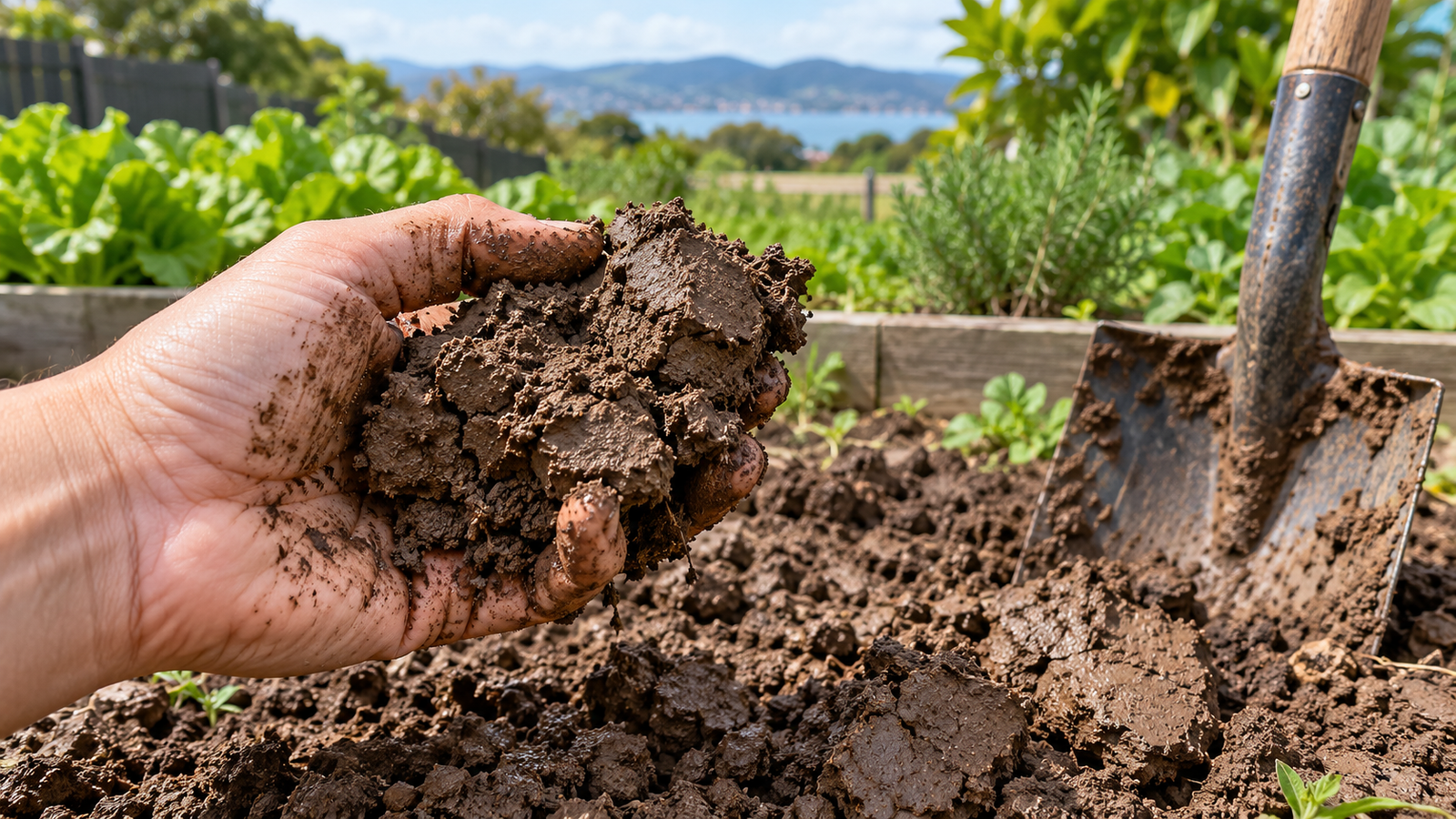
Heavy clay soil can make gardening feel harder than it needs to be. After winter rain, the ground may stay wet, sticky and difficult to work. Then summer arrives and the same soil can dry into hard clumps that seem almost impossible to dig.
It is a familiar problem in New Zealand gardens.
The good news is that clay soil is not necessarily bad soil. It can hold plenty of moisture and nutrients. The real challenge is usually its structure and drainage.
With organic matter, careful cultivation and, where necessary, better drainage or raised planting areas, heavy clay can become productive garden soil. The important thing is to improve it gradually rather than trying to replace or “fix” everything in a weekend.
How do you know if you have clay soil?
Clay contains extremely fine mineral particles. When there is a high proportion of these particles, they can pack closely together and leave relatively little space for air and water movement.
You may have clay-heavy soil if it:
- feels sticky and mouldable when wet
- forms dense clumps
- remains wet long after rain
- is difficult to dig when saturated
- becomes very firm when dry
- develops surface cracks during prolonged dry weather
- produces puddles or slow-draining areas after heavy rain
One simple test is to take a handful of moist soil and squeeze it. Sandy soil tends to fall apart readily. Soil with substantial clay content is much more likely to hold together and can often be rolled or moulded between your fingers.
If water regularly pools in exactly the same place, investigate where that water is coming from before adding bags of soil amendments.
Why is clay soil difficult to garden in?
Clay behaves very differently depending on how much water it contains.
It can drain slowly
The small particles in clay-heavy ground can create a dense structure with limited pore space. After prolonged rain, water may move through the soil slowly.
Plant roots still require oxygen, so permanently saturated ground can create an unhealthy root environment. This is why a plant that appears perfectly happy during a dry spell can struggle after weeks of winter rain.
It can become very hard when dry
The opposite problem appears during dry periods. As clay loses moisture, the soil can become dense and hard. In some gardens, the surface may even crack.
Digging, planting and weeding become much more difficult once the ground reaches this state.
It is easy to compact
Walking over wet clay or repeatedly working saturated ground can damage its structure.
Clay soil also has advantages
Before deciding that all your existing soil needs to disappear, remember that clay has useful characteristics.
Clay soils can:
- hold nutrients well
- retain useful moisture
- support many trees and shrubs
- become productive once their structure improves
- require less frequent watering than very sandy soils in some conditions
The objective is therefore not necessarily to turn clay into another soil type. Instead, aim to create better structure, more pore space, healthier biological activity and appropriate drainage.
How to improve clay soil in a New Zealand garden
For most home gardens, start with five principles:
- Avoid digging saturated clay.
- Add organic matter.
- Protect the surface with mulch.
- Reduce compaction.
- Fix genuine drainage problems separately.
Some gardens will also benefit from gypsum or raised planting areas, but those decisions should come after understanding the site.
1. Don’t work clay soil when it is soaking wet
This is one of the easiest mistakes to avoid.
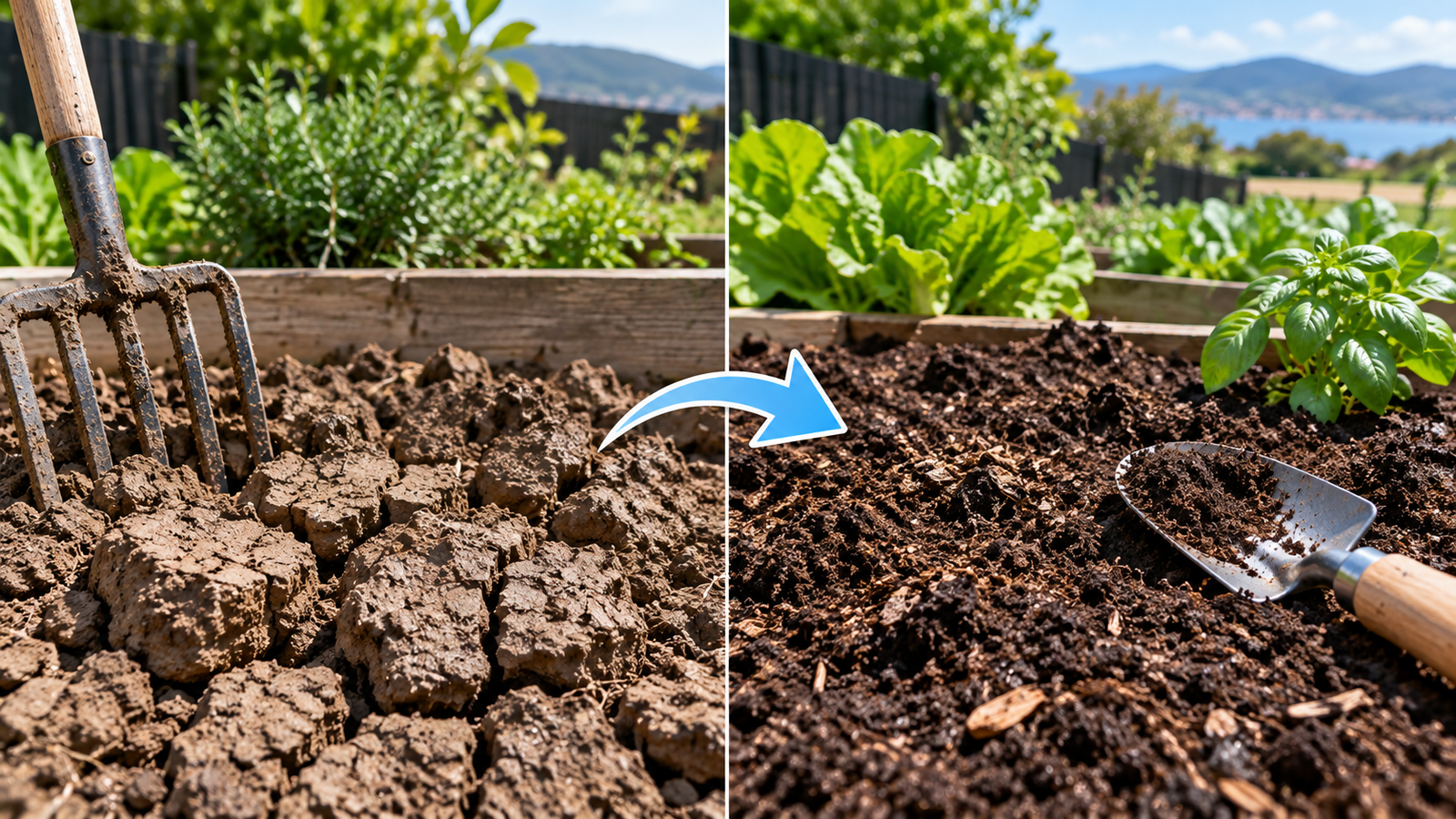
Wet clay is highly vulnerable to compaction and smearing. Digging it while saturated can leave dense clods and smooth surfaces that become even harder once they dry.
Wait until the ground is moist but workable.
A useful practical test is to pick up some soil and squeeze it. If it is extremely sticky, shiny and smears easily, give it more time. If it breaks apart reasonably well rather than behaving like modelling clay, conditions are much better for working the bed.
2. Add plenty of organic matter
For most home gardeners, organic matter should be the foundation of clay-soil improvement.
Good options include:
- mature compost
- well-rotted manure
- decomposed leaf material
- suitable garden mixes
- other well-decomposed organic materials
Organic matter helps create a more open soil structure and supports soil organisms. Rather than adding a token handful of compost to individual planting holes, improve a wider area whenever possible.
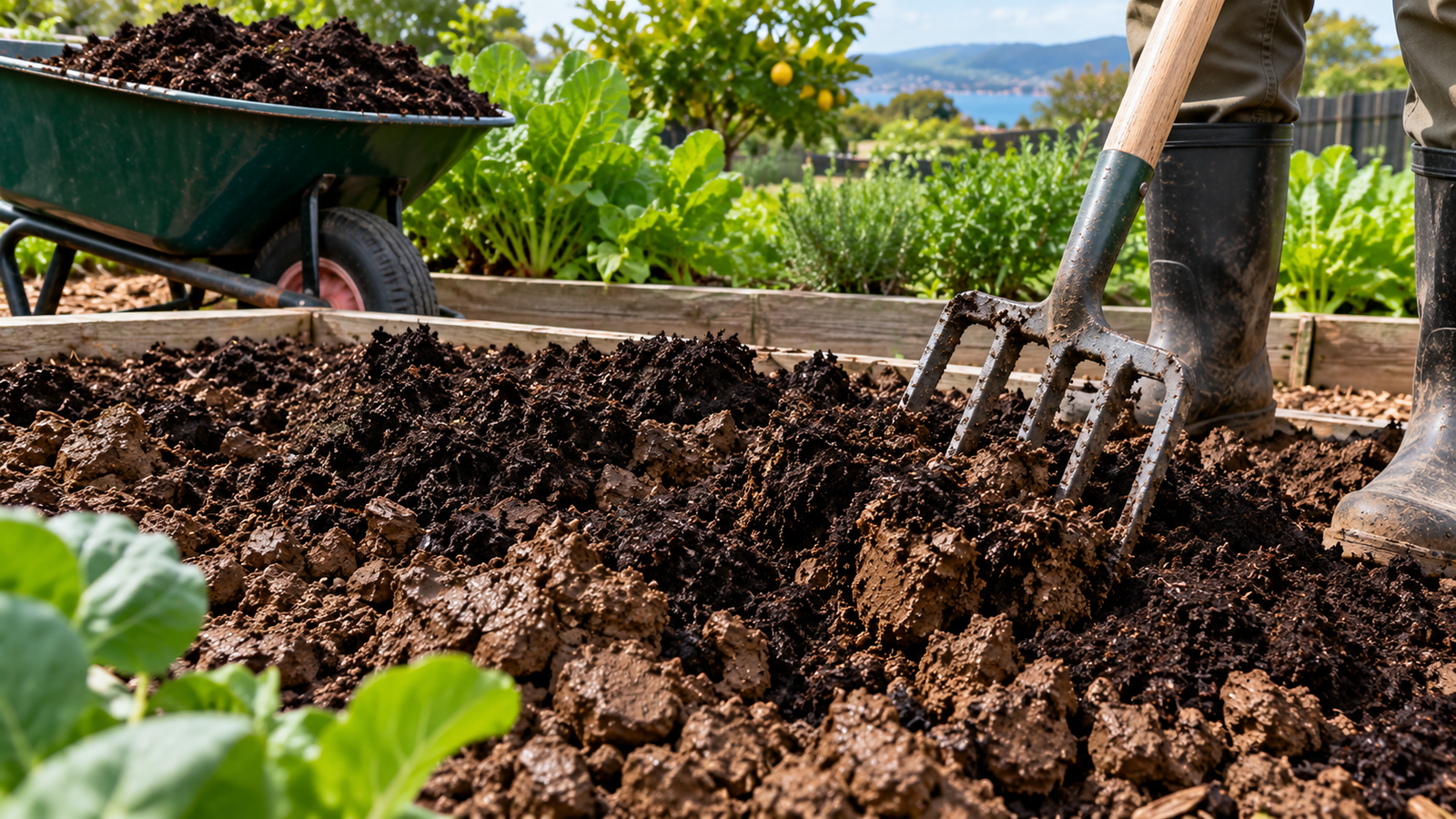
For a new garden bed, spread a generous layer of mature compost over the surface and incorporate it into the workable upper soil.
How much compost should you add?
There is no single quantity suitable for every garden because clay severity, existing topsoil and intended planting vary.
For seriously clay-heavy beds, think in terms of a substantial layer rather than a light dusting. The goal is not to create a pocket of pure compost. It is to gradually improve the existing soil.
3. Use a garden fork to open compacted ground
A sturdy garden fork is particularly useful when working with heavy soil. Where conditions allow, push the fork into the ground and gently loosen compacted areas rather than pulverising the entire bed.
The objective is to create openings for air, roots, organic material and water movement.
A garden fork is also one of the tools included in our guide to the 12 essential garden tools for NZ home gardeners.
Should you use gypsum on clay soil?
This deserves more explanation than the usual “add gypsum” advice.
Gypsum — calcium sulphate — is widely sold as a clay soil conditioner. Calcium can help clay particles aggregate under suitable soil conditions, improving structure.
But gypsum should not be treated as magic powder that automatically transforms every clay soil.
Its effectiveness depends on the soil’s chemistry and the reason for the structural problem.
- prioritise organic matter first
- investigate your soil rather than automatically applying amendments
- follow product rates if using a commercial soil conditioner
- consider soil testing when dealing with a large area or persistent problem
Gypsum and garden lime are also not interchangeable. Lime is commonly used to alter soil acidity, while gypsum supplies calcium without having the same liming effect. Avoid changing soil pH blindly.
Can gypsum improve drainage?
Sometimes — indirectly.
Where gypsum improves the aggregation of suitable clay particles, larger pore spaces can develop and water movement can improve.
But gypsum cannot fix a garden sitting in a natural low point, water running onto the property, a blocked drainage system, severe subsoil compaction, an impermeable layer beneath the improved soil or poor site grading.
Fix drainage problems separately
This distinction is important.
Clay soil and poor site drainage are related, but they are not exactly the same problem.
Suppose water flows from a driveway or slope into one garden bed. Improving the top layer of soil may make the bed nicer to work, but it does not stop the incoming water.
Likewise, digging a deep hole into dense clay and filling it with beautiful free-draining soil can sometimes create a container in the ground. Water moves into the amended area but cannot readily escape through the surrounding clay.
This is often described as the “bathtub effect”.
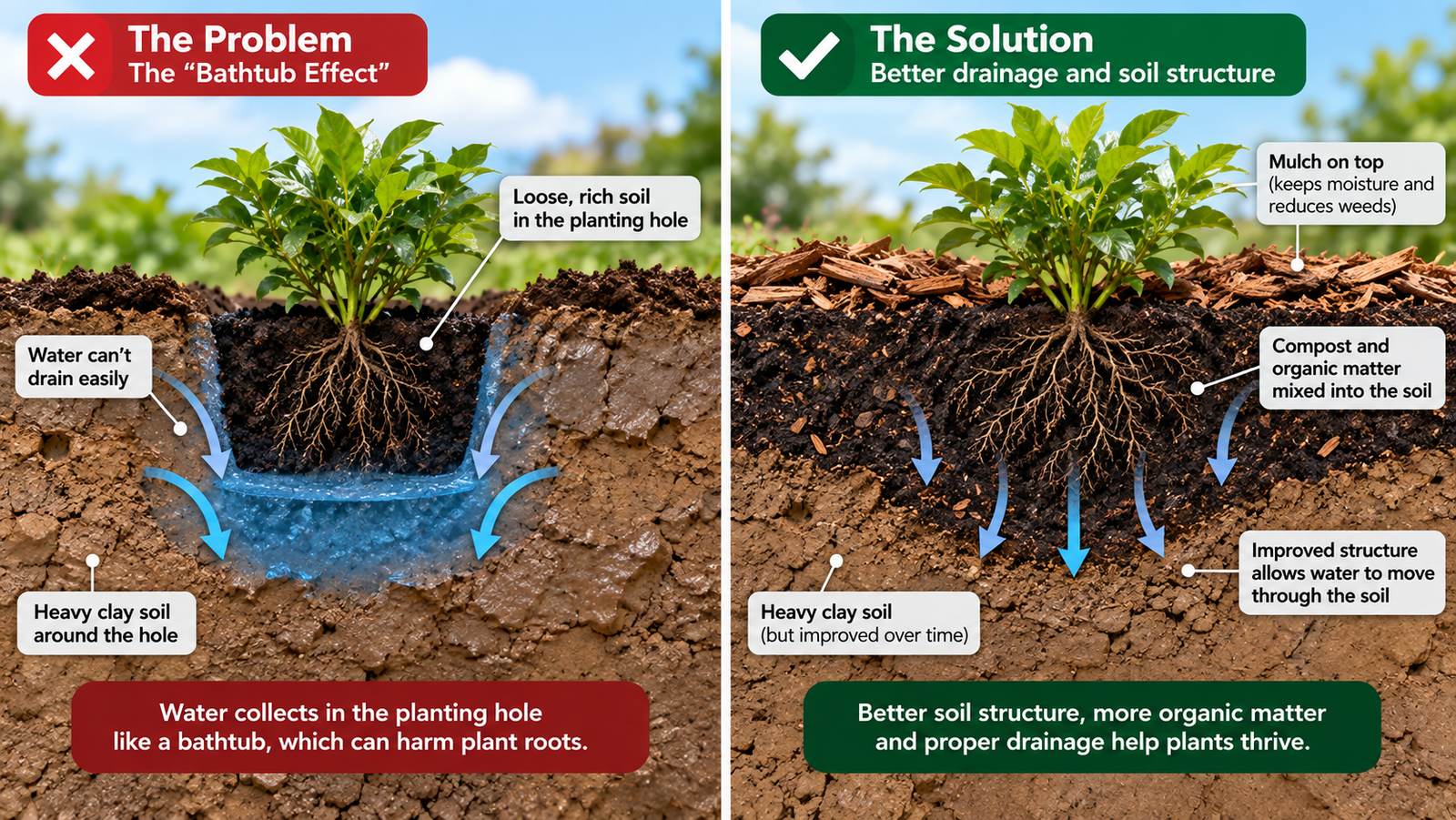
If you are planting into heavy clay, prepare a broad area rather than creating an isolated deep pocket of soft material.
For persistently waterlogged sites, solutions may include:
- raising the planting level
- redirecting surface water
- correcting the ground slope
- installing appropriate drainage
- using a raised garden bed
If standing water is a major problem in your section, read our dedicated guide to garden drainage in New Zealand as well.
Raise the planting area when necessary
Sometimes the easiest solution is not fighting the clay underneath.
Raising the root zone gives plants access to better-aerated growing media above the worst of the heavy ground.
You do not necessarily need a tall vegetable box. For ornamental planting, simply mounding or raising the bed above the surrounding ground can improve conditions, provided excess water still has somewhere to go.
For vegetables and herbs, a proper raised bed provides much greater control over the growing medium.
This can be particularly useful on:
- very heavy clay
- compacted new-build sites
- frequently waterlogged sections
- gardens where improving the entire soil profile would be impractical
Our Raised Garden Beds NZ guide covers materials, dimensions, drainage and growing media in much greater detail.
Mulch the surface
Once you have started improving the soil, protect it.
Organic mulch can help:
- reduce moisture loss during summer
- moderate soil temperature
- suppress weeds
- protect the surface from heavy rain
- add organic material as it gradually decomposes
Suitable options may include arborist wood chips, bark products, composted materials, leaf litter or pea straw depending on the garden.
Do not pile mulch directly against trunks, stems or plant crowns. Leave a small gap around the plant itself.
Clay often swings between two extremes — too wet and too dry — and mulch is particularly useful for reducing the severity of the dry end of that cycle.
Should you add sand to clay soil?
This is where DIY soil advice can go badly wrong.
Adding a small amount of sand to heavy clay is not a reliable shortcut to creating beautiful loam.
The final texture depends on particle proportions, and simply mixing a few bags of sand into a clay bed may do very little to improve it.
For an ordinary home gardener, good-quality organic matter is generally a much more practical starting point.
Should you add topsoil?
Topsoil can be useful when you need to raise the level of a bed, but simply covering clay with a thin layer of topsoil does not make the underlying drainage problem disappear.
Think about the complete soil profile.
If you create a sharply defined layer of loose soil sitting over severely compacted clay, roots and water will eventually reach that boundary.
How to plant shrubs and trees in clay soil
A classic mistake is digging a relatively small, deep hole and filling it entirely with compost or premium garden mix.
It feels logical: give the new plant a perfect pocket of soil. Unfortunately, in dense clay that pocket may collect water.
- Check drainage before planting. Observe how quickly water disappears after rain.
- Prepare an area wider than the root ball. Avoid creating a narrow, deep pocket.
- Avoid planting unnecessarily deep. Keep the root system at an appropriate level.
- Loosen suitable surrounding soil. Work only when conditions allow.
- Use organic matter sensibly. Improve the wider soil rather than creating an isolated pocket.
- Mulch after planting. Keep mulch away from the trunk or crown.
- Monitor moisture. Do not assume a clay garden needs more water simply because the surface looks dry.
What plants grow well in clay soil in New Zealand?
You do not always need to change the entire garden to suit your plants. Sometimes it makes more sense to choose plants suited to the garden you already have.
Several New Zealand natives can tolerate heavier soils, although tolerance varies enormously between species and sites.
Potential candidates include certain:
- Carex species
- harakeke / flax
- tī kōuka / cabbage tree
- Coprosma
- mānuka
- kōwhai
- Pittosporum
Sun, frost, wind, coastal exposure and regional climate also matter. Our guide to the best native plants for New Zealand gardens can help you narrow down suitable choices.
Improving clay soil for a vegetable garden
Vegetables make the limitations of poor soil particularly obvious because many are relatively fast-growing and need healthy root systems.
If the existing clay is workable, improve it progressively with mature compost and other suitable organic matter.
Keep permanent paths wherever possible so you are not repeatedly walking over growing areas. Mulch exposed soil and replenish organic material between crops.
If the underlying clay remains extremely difficult or poorly drained, a raised vegetable bed may provide faster results than trying to rehabilitate the entire area immediately.
Improving clay soil for a lawn
A clay lawn requires a slightly different strategy because you cannot simply dig large quantities of compost through established turf.
First identify the problem. Is the lawn actually suffering because of clay, or is it compacted from foot traffic, shaded, receiving runoff, sitting in a low spot, affected by poor grading or holding water because the underlying soil was compacted during construction?
Aeration can help relieve compaction in appropriate situations, but serious standing-water problems may require drainage or changes to levels.
Avoid repeatedly working or walking over a saturated lawn because that can make compaction worse.
What about clay soil in new-build properties?
This deserves special attention.
During construction, topsoil may be moved and heavy machinery can compact the remaining ground.
The result can look like a normal garden once a thin layer of soil and turf has been placed on top, while dense material remains underneath.
Before spending heavily on plants, investigate the soil profile. Dig in several locations and look for:
- shallow topsoil
- heavily compacted subsoil
- construction debris
- standing water
- abrupt changes between soil layers
If the entire section has a structural drainage problem, buying more compost alone may not solve it.
A simple clay-soil improvement plan
If you have inherited a heavy clay garden and do not know where to begin, use this sequence:
- Observe after rain. Find out where water sits and how long it remains.
- Check the soil. Determine whether the problem is clay, compaction, poor grading or a combination.
- Wait for workable conditions. Do not attack saturated clay with a rotary cultivator or spade.
- Loosen compacted areas. Use a fork where appropriate and avoid unnecessary traffic.
- Add organic matter. Incorporate mature compost into the workable upper soil across a broad area.
- Deal with drainage. If water has nowhere to go, address that problem separately.
- Plant appropriately. Match species to drainage, climate, sun and exposure.
- Mulch. Protect the improved surface and continue adding organic matter over time.
How long does it take to improve clay soil?
There is no honest “seven-day transformation”.
You may notice an immediate improvement in workability after incorporating good organic matter, but changing the structure and biological condition of a garden bed is a longer process.
Expect to keep improving it over multiple seasons.
The good news is that you do not need to wait years before planting anything. You can improve specific beds first, use raised beds for vegetables and choose clay-tolerant plants elsewhere while the broader garden gradually develops.
This is often more realistic — and cheaper — than attempting to replace the soil across an entire section.
Common clay-soil mistakes
Working it while saturated
This encourages compaction and poor structure.
Digging a deep planting “bathtub”
A small hole filled with free-draining material can still hold water if dense clay surrounds it.
Assuming gypsum fixes everything
It can be useful under appropriate conditions, but it cannot correct every soil or drainage problem.
Adding a little sand and expecting loam
Soil texture does not work that simply.
Ignoring where water comes from
Runoff and poor grading require water-management solutions.
Adding organic matter once and stopping
Organic materials decompose. Healthy soil management is ongoing.
Frequently asked questions
What is the fastest way to improve clay soil?
For an existing garden bed, adding mature organic matter and addressing drainage where necessary can produce the most useful practical improvement. If the ground is extremely difficult, creating a raised bed may provide a usable growing area much faster.
Is gypsum good for clay soil in NZ?
Gypsum can improve the structure of some clay soils by supplying calcium without substantially changing soil pH. However, results depend on the soil’s characteristics, so it should not be considered a universal solution for every clay garden.
Does compost break up clay soil?
Compost does not change clay particles into another soil type, but regular additions of organic matter can improve soil structure, workability, aeration and biological activity.
Can I put topsoil over clay?
You can use topsoil or garden mix to raise a planting area, but a shallow layer over badly compacted clay will not automatically fix drainage. Consider how water will move through the entire soil profile.
Can I plant directly into clay soil?
Yes. Many plants can grow in clay. Success depends on the severity of the clay, drainage and the plant species. Improve the surrounding soil where appropriate and avoid creating isolated planting holes that collect water.
Are raised garden beds good for clay soil?
Yes. Raised beds can be particularly useful where native ground is compacted or poorly drained because they provide a controlled root zone above the worst soil. Drainage beneath and around the bed still needs consideration.
Should I dig clay soil in winter?
Avoid digging when clay is saturated and sticky. Wait until it has dried enough to crumble and be worked without smearing or compacting.
Why is my clay soil wet in winter but rock-hard in summer?
Clay particles are extremely fine. Clay-heavy ground can retain substantial water when wet, yet shrink and become dense as it dries. Organic matter and mulch can help moderate these extremes over time.
Final verdict
Clay soil does not need to be removed to create a successful New Zealand garden.
Start by determining whether you actually have a soil-structure problem, a drainage problem or both. Add organic matter regularly, avoid working saturated ground, protect the soil with mulch and use raised planting areas when the existing conditions are simply too difficult.
Use gypsum selectively rather than automatically, and choose plants suited to the site you actually have.
The goal isn’t perfect soil. It’s soil that drains appropriately, remains workable and gives roots the air, moisture and space they need to grow.
Related Articles
2 Comments
[…] your garden has heavy clay, read our Clay Soil NZ guide before planting. Improving a broader area is generally better than digging a small hole and filling […]
[…] heavy ground is part of the problem, read our guide to improving clay soil in New Zealand before establishing a large […]