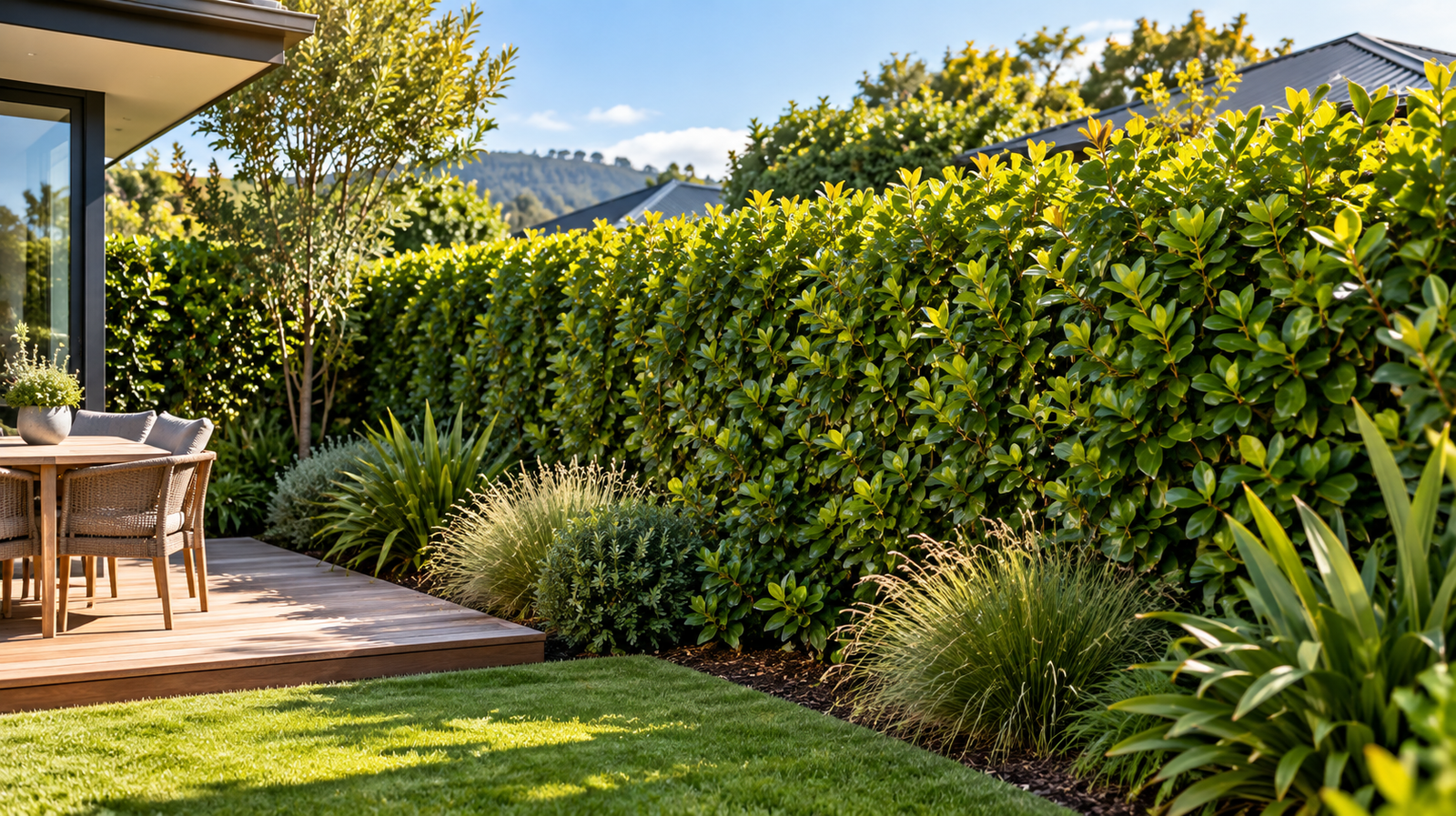
12 Best Privacy Plants NZ Gardens Can Grow: Hedges & Native Screens
Looking for the best privacy plants NZ gardens can grow? A good privacy screen can completely change how a garden feels. It can turn an exposed deck into somewhere you actually want to sit, soften the view of neighbouring properties, reduce wind and make even a small urban section feel more private.
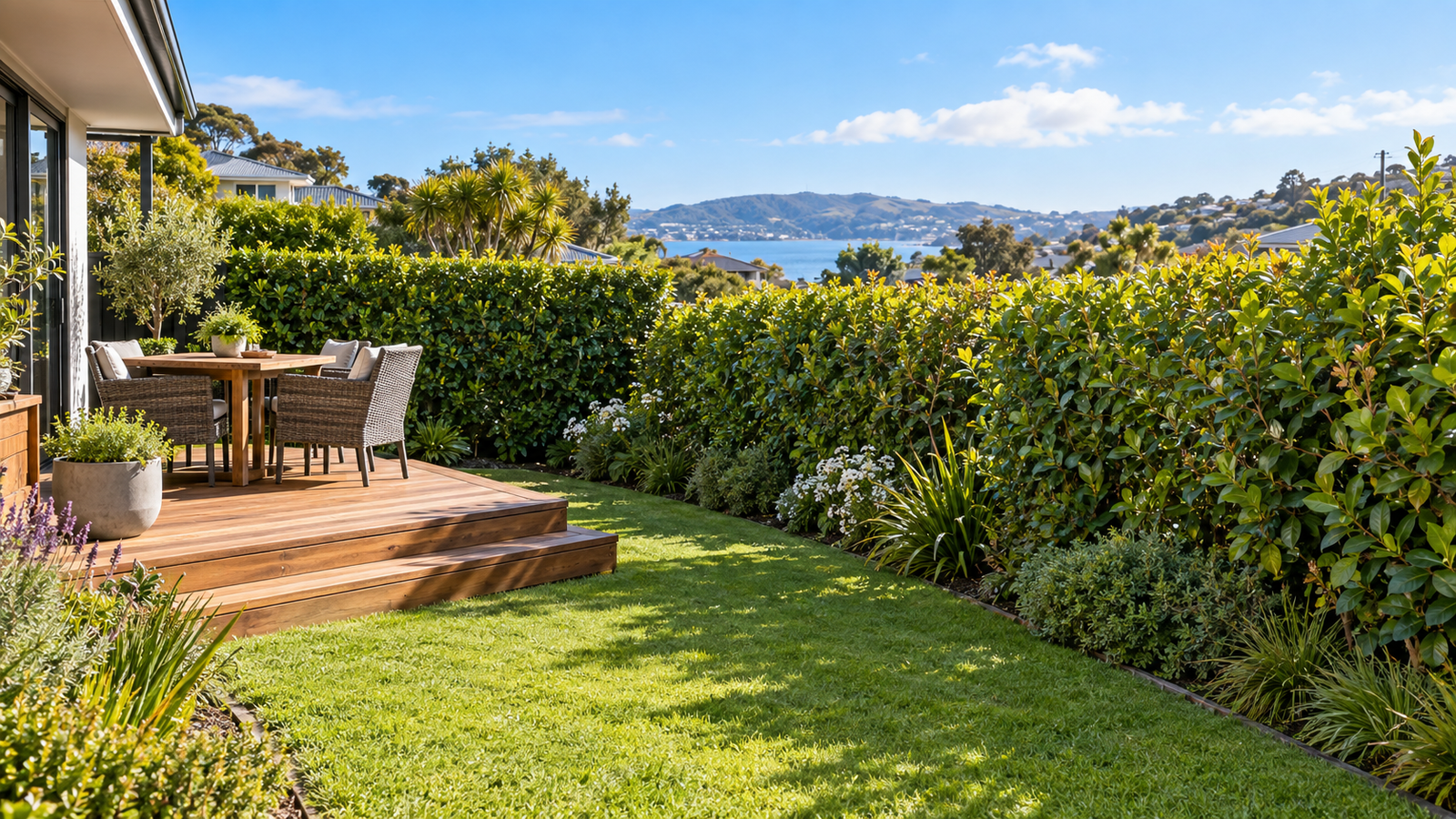
But choosing a privacy plant in New Zealand isn’t as simple as buying whatever has the words “fast growing” on the label.
A plant that thrives behind a sheltered Auckland fence may struggle with salt-laden wind on the coast. Something perfect for a large rural section could become a constant pruning job in a narrow suburban garden.
The goal isn’t simply to grow something tall. It’s to create a dense, healthy and manageable screen that suits your particular site.
For relatively fast native screening, Pittosporum is another excellent option. Smaller gardens may suit Corokia, while exposed coastal properties should look closely at hardy options such as karo.
Quick Picks: Best Privacy Plants NZ Gardeners Should Consider
| Need | Our pick | Why |
|---|---|---|
| Best all-rounder | Griselinia | Dense, evergreen and tolerant of exposed conditions |
| Fast-growing native | Pittosporum | Vigorous growth and excellent screening potential |
| Smaller hedge | Corokia | Dense growth that can be kept compact |
| Exposed coastal garden | Karo | Useful for wind and coastal exposure |
| Dry, windy position | Akiraho | Useful on exposed, free-draining sites |
| Long-term formal hedge | Tōtara cultivar | Hardy and capable of forming a dense clipped hedge |
| Colourful screen | Akeake | Attractive foliage and relatively quick growth |
| Flowering native screen | Mānuka | Privacy plus flowers and pollinator value |
| Architectural screening | Harakeke | Bold foliage for informal screening |
How to Choose the Best Privacy Plants NZ Gardens Need
When comparing privacy plants NZ homeowners can grow, look beyond speed alone. Mature width, wind exposure, salt tolerance, drainage and the amount of pruning required can make a much bigger difference over time.
It’s easy to focus on one question: How quickly will it grow?
But that shouldn’t be the first question.
Drainage matters too. Some excellent screening plants dislike sitting in wet ground, while others cope much better with difficult conditions.
If heavy ground is part of the problem, read our guide to improving clay soil in New Zealand before establishing a large hedge.
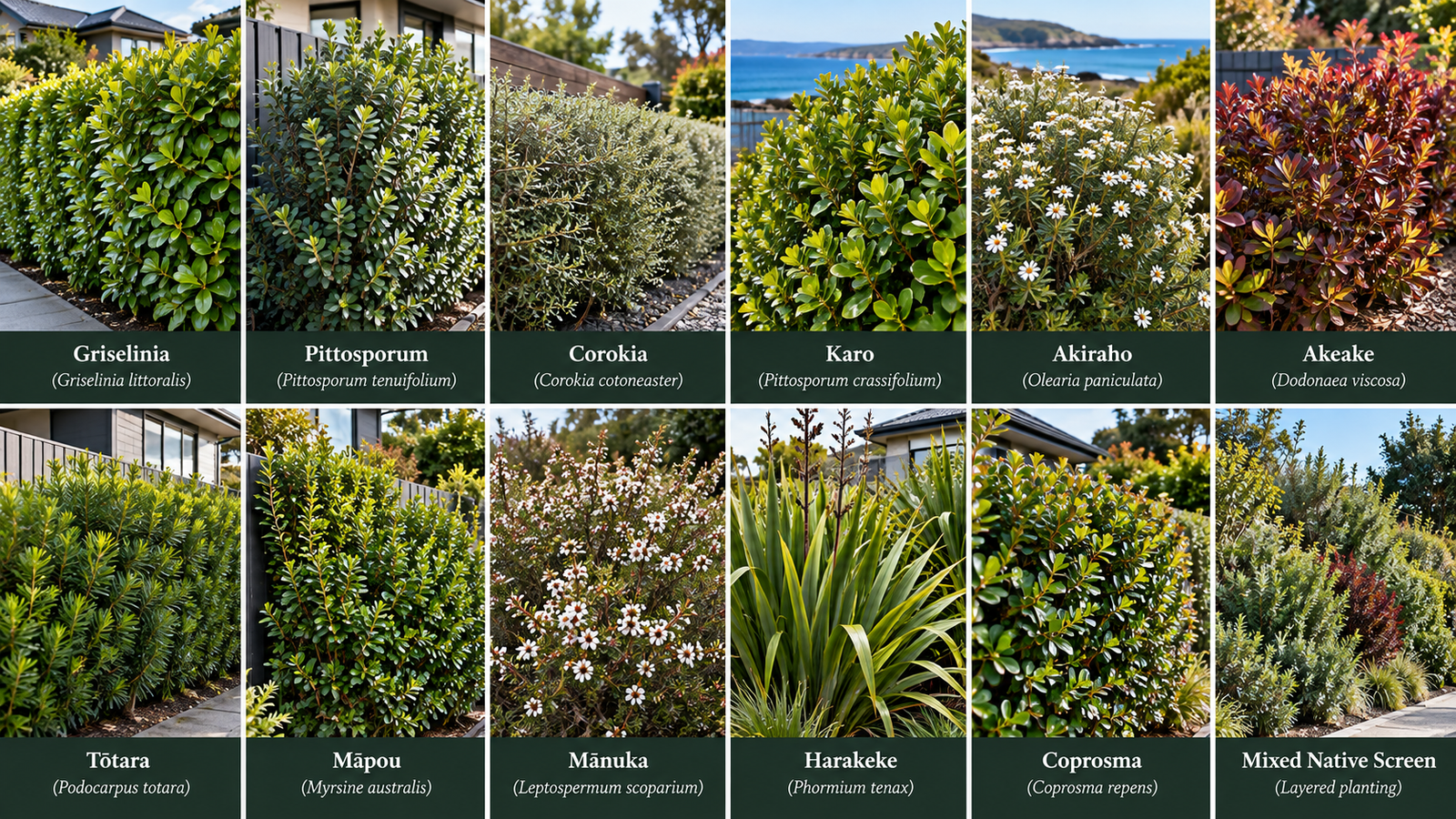
12 Privacy Plants NZ Gardens Can Use for Screening
1. Griselinia littoralis — Best Overall Privacy Hedge
Evergreen Native HedgeBest for: general screening, formal hedges and exposed gardens.
If you want one plant that ticks a lot of boxes, Griselinia deserves to be near the top of the list.
Also known as kāpuka, Griselinia littoralis is a New Zealand native evergreen with thick, glossy green foliage. The New Zealand Plant Conservation Network lists the species as a native endemic taxon.
It responds well to clipping and can be used as a neat formal hedge or kept slightly looser for a softer, more natural screen.
The species can eventually become a substantial tree if left unpruned, which is why regular trimming matters when you’re using it as a suburban boundary hedge.
2. Pittosporum — Best Fast-Growing Native Screen
Native Relatively fast Tall screeningBest for: quicker screening, taller hedges and native-style gardens.
Pittosporum is one of the first groups worth considering if your goal is to establish privacy relatively quickly.
But Pittosporum isn’t one single garden plant. There are numerous species and cultivars ranging from compact shrubs to substantial screening plants.
Kōhūhū (Pittosporum tenuifolium) is a well-known New Zealand native and is commonly used for hedging and screening.
That vigorous growth is both its advantage and its trade-off: faster screening generally means more frequent trimming.
3. Corokia — Best for Smaller Privacy Hedges
Compact Native Wind tolerantBest for: compact gardens, narrow hedges and windy sites.
Not everybody needs a towering green wall. Sometimes you simply need enough screening to separate an outdoor seating area from a path or neighbouring property.
Corokia can create dense growth while remaining easier to manage at a smaller scale than many large screening species.
Its fine branching also creates a very different texture from the broad glossy leaves of Griselinia.
4. Karo — Best for Harsh Coastal Exposure
Coastal Wind tolerant NativeBotanical name: Pittosporum crassifolium
Best for: coastal gardens and exposed sites.
Living near the coast changes the rules. Persistent wind and salt exposure can make otherwise excellent hedge plants struggle.
Karo is a strong candidate for these environments and can be clipped into a useful privacy hedge.
Because it can naturally become a substantial shrub or small tree, regular trimming is important in smaller residential spaces.
5. Akiraho — Best for Dry, Windy Gardens
Dry sites Exposed sitesBotanical name: Olearia paniculata
Akiraho is useful where exposure and relatively dry conditions make more delicate privacy plants difficult to establish.
It works particularly well as an informal hedge and produces fragrant white flowers.
6. Akeake — Best for Fast Growth and Foliage Colour
Fast-growing Full sunBotanical name: Dodonaea viscosa
Akeake is an attractive native shrub or small tree that can establish relatively quickly in suitable conditions.
Purple-leaved forms are particularly useful if you want a privacy screen with more visual contrast than a conventional green hedge.
It prefers sun and doesn’t appreciate waterlogged ground.
7. Tōtara — Best Long-Term Formal Native Hedge
Hardy Formal hedge Long-termTōtara probably isn’t the first plant that comes to mind when someone says “hedge”, but suitable cultivars can produce dense and handsome formal screening.
The Auckland Botanic Gardens hedge guide specifically notes that tōtara can be used as a hedge when regularly pruned.
The key is cultivar selection. Compact forms are much more practical for residential hedging than simply planting an unrestricted forest tree.
You’re trading maximum speed for structure, density and longevity.
8. Māpou — An Underrated Native Hedge
Native EvergreenBotanical name: Myrsine australis
Māpou doesn’t get the same attention as Griselinia or Pittosporum, but it’s well worth considering.
It forms a bushy shrub or small tree and brings more visual character through its leathery leaves and reddish young branches.
It’s particularly attractive if you want native screening without planting exactly the same hedge found on every second street.
9. Mānuka — Best Flowering Native Screen
Flowers Pollinators Informal screenBotanical name: Leptospermum scoparium
Privacy doesn’t have to mean a featureless green wall.
Mānuka can provide screening while bringing flowers, seasonal interest and pollinator activity into the garden.
Cultivar selection is important because mature dimensions vary considerably.
10. Harakeke — Best for Architectural Screening
Bold foliage Informal NativeBotanical name: Phormium tenax
Not every privacy screen needs to be a hedge.
Harakeke creates strong upright foliage and an unmistakably New Zealand character. It works beautifully for breaking sightlines, screening parts of decks, disguising utilities and building layered planting.
It is particularly effective when used in front of taller shrubs rather than expected to form one perfectly solid wall by itself.
11. Coprosma — Best for Mild Coastal Gardens
Coastal EvergreenCoprosma includes a large range of native species and cultivars, many of which offer glossy evergreen foliage and useful screening potential.
Taupata (Coprosma repens) can form dense screening when appropriately selected and maintained.
12. Mixed Native Screening — Best for a Natural-Looking Boundary
Here’s the option that often gets ignored:
Don’t plant a conventional hedge at all.
Instead, combine taller plants such as Pittosporum or Griselinia with smaller native shrubs and architectural plants such as Corokia and harakeke.
The result can create different heights, seasonal flowers, habitat and a much more natural texture than a perfectly clipped green wall.
Best Privacy Plants by Situation
For Auckland and Mild Northern Areas
Consider Griselinia, Pittosporum, Coprosma, Corokia and akeake. Exposure still matters: a sheltered suburban property and an exposed coastal section shouldn’t automatically use the same plants.
For Wellington and Windy Sites
Start by prioritising wind tolerance. Griselinia, Corokia, Olearia and appropriately selected Pittosporum are all worth investigating.
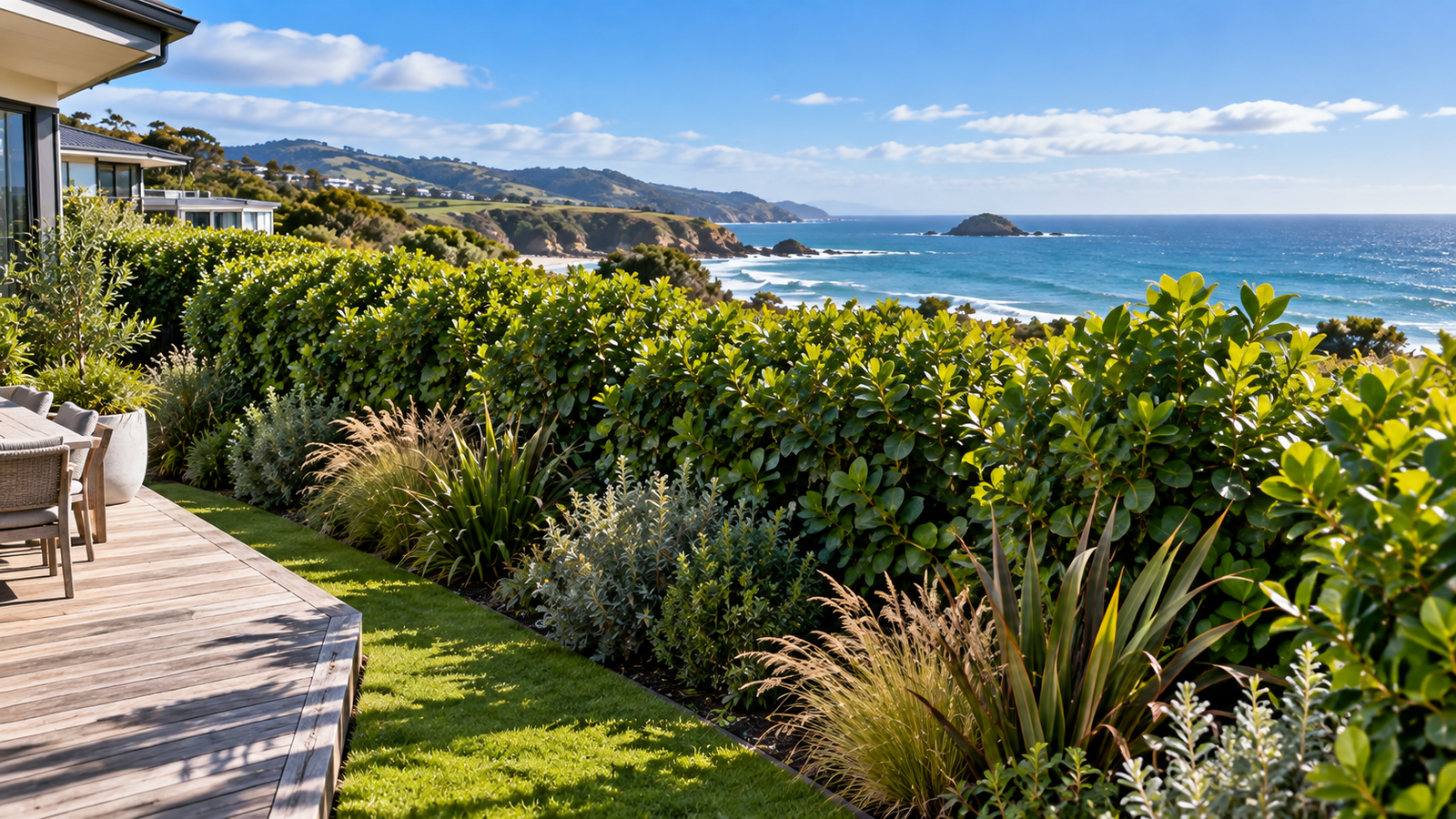
For Coastal Gardens
Direct salt exposure changes the shortlist considerably. Karo and Griselinia are useful candidates to investigate where wind and coastal exposure are major considerations.
For Frost-Prone Areas
Start with plants and cultivars documented as suitable for your local winter conditions. Frost tolerance can vary even among plants commonly recommended for New Zealand gardens.
How Far Apart Should Privacy Plants Be?
There isn’t one universal spacing number.
Spacing depends on:
- species and cultivar
- starting plant size
- desired hedge height
- how quickly you want plants to meet
- available moisture and nutrients
- the mature width of the plant
Plant too far apart and you may stare through gaps for years. Plant too closely and the plants can compete unnecessarily for water, nutrients and light.
As one useful reference point, Auckland Botanic Gardens gives 90 cm spacing for Griselinia, while also stressing that optimum hedge spacing varies according to the plant type.
How to Plant a Privacy Hedge Properly
A fast-growing plant won’t rescue poor establishment. Give the hedge a strong start.
- Mark the hedge line. Use string rather than guessing if you want a straight formal hedge.
- Remove competing weeds. Young plants shouldn’t immediately compete with established weeds for moisture.
- Check drainage. This is particularly important for plants that dislike wet feet.
- Plant at the correct depth. Avoid burying the plant substantially deeper than it was growing in its container.
- Water thoroughly. Make sure water reaches the root zone rather than only wetting the surface.
- Add mulch. Mulch can help suppress weeds and conserve soil moisture.
- Water through establishment. Young hedges need time to establish their root systems.
Auckland Botanic Gardens recommends autumn hedge planting so roots can establish during the winter months. Their guidance also recommends watering before and after planting, using a string for alignment and mulching with organic matter.
Pruning Privacy Plants NZ Gardens for a Dense Hedge
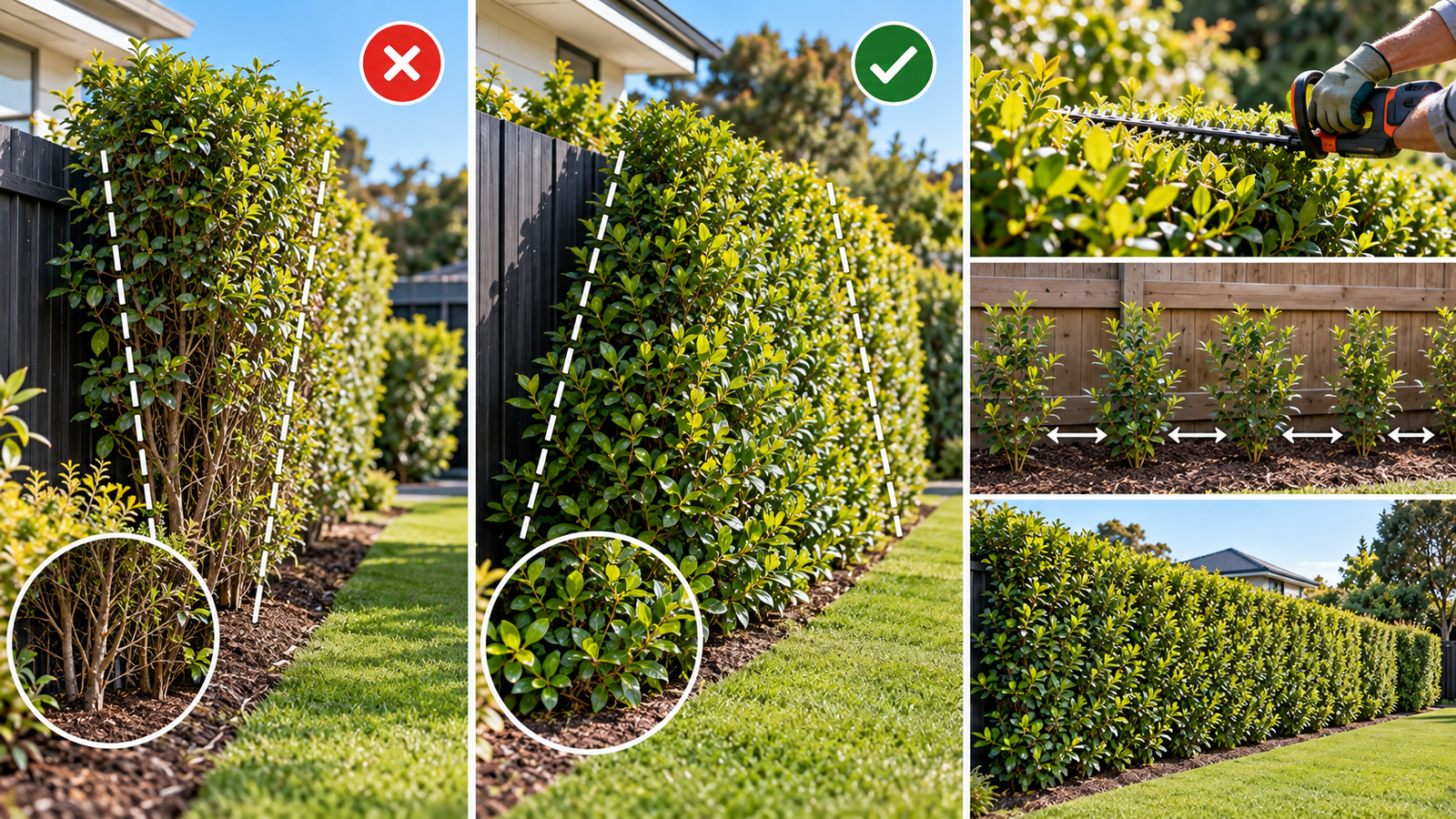
One of the biggest hedge mistakes happens because gardeners want height as quickly as possible.
So they don’t prune.
The plants race upwards — and several years later you’re left with tall growth and an increasingly bare base.
Instead, encourage branching while the plants are young.
Keep the Base Slightly Wider Than the Top
A good formal hedge shouldn’t become wider at the top than at the bottom.
Instead, aim for a subtle taper with the base slightly wider than the top.
Auckland Botanic Gardens recommends this general shape because it allows more light to reach lower foliage and helps prevent leaf drop near the base.
Fast-Growing Isn’t Always Better
Imagine two plants.
Plant A reaches your desired screen height quickly but needs trimming several times every year.
Plant B takes longer but becomes a stable hedge requiring much less intervention.
Which is better?
That depends entirely on your situation.
If a neighbouring balcony suddenly overlooks your deck, speed may matter enormously.
If you’re landscaping a property you intend to live in for the next 20 years, maintenance may matter much more.
Ask: “What’s the fastest privacy plant I’m willing to maintain for the next ten years?”
Native vs Exotic Privacy Plants
There are excellent exotic hedge plants, but New Zealand gardeners also have an unusually interesting range of native screening choices.
Griselinia, Pittosporum, Corokia, karo, māpou, mānuka, harakeke and other natives can create everything from highly formal hedges to loose, layered screening.
But “native” doesn’t automatically mean “suitable everywhere”.
A plant adapted to one New Zealand habitat may still struggle somewhere with very different rainfall, soil, frost or exposure.
Privacy Plants NZ: Frequently Asked Questions
What is the best privacy plant in New Zealand?
For a general-purpose evergreen hedge, Griselinia littoralis is one of the strongest all-round choices. The best plant for your property still depends on climate, exposure, soil and available space.
What is a fast-growing native hedge in NZ?
Pittosporum is one of the most useful options to investigate when relatively quick native screening is a priority. Growth will still vary according to cultivar and site conditions.
What is a good hedge for coastal NZ?
Griselinia and karo are both worth considering for exposed coastal gardens, but the severity of salt and wind exposure should guide the final choice.
What’s a good privacy hedge for a small garden?
Corokia is worth considering because it can form dense growth while remaining manageable. Compact cultivars of other hedge species may also work, but always check mature width before planting.
How long does a privacy hedge take to grow?
There is no useful universal number. Species, cultivar, starting size, climate, soil, irrigation, spacing and pruning can all dramatically affect establishment and growth.
When is the best time to plant a hedge in NZ?
Autumn is often an excellent planting period. Auckland Botanic Gardens recommends autumn hedge planting so roots can establish during the winter months.
Final Verdict: Choosing the Best Privacy Plants NZ
If you want the simplest shortlist, start with five:
Griselinia for the best all-rounder.
Pittosporum when quicker screening is the priority.
Corokia when space is tighter.
Karo for difficult coastal exposure.
Tōtara when you want a substantial long-term native hedge.
The best privacy plants NZ gardeners can choose are ultimately the ones suited to their local conditions, available space and preferred level of maintenance.
Walk outside first. Look at the space. Think about the wind. Check where the sun falls. Look at the soil after heavy rain. Measure how wide the hedge can actually become — and decide how often you’re genuinely prepared to trim it.
The best privacy hedge isn’t the plant that reaches two metres first. It’s the one you’re still happy you planted ten years from now.
Related Articles
1 Comment
[…] Ideal for: roses, flowers, soft shoots, most routine shrub pruning and live fruit-tree growth within the tool’s capacity. If you are shaping hedges for screening, see our guide to privacy plants for NZ gardens. […]