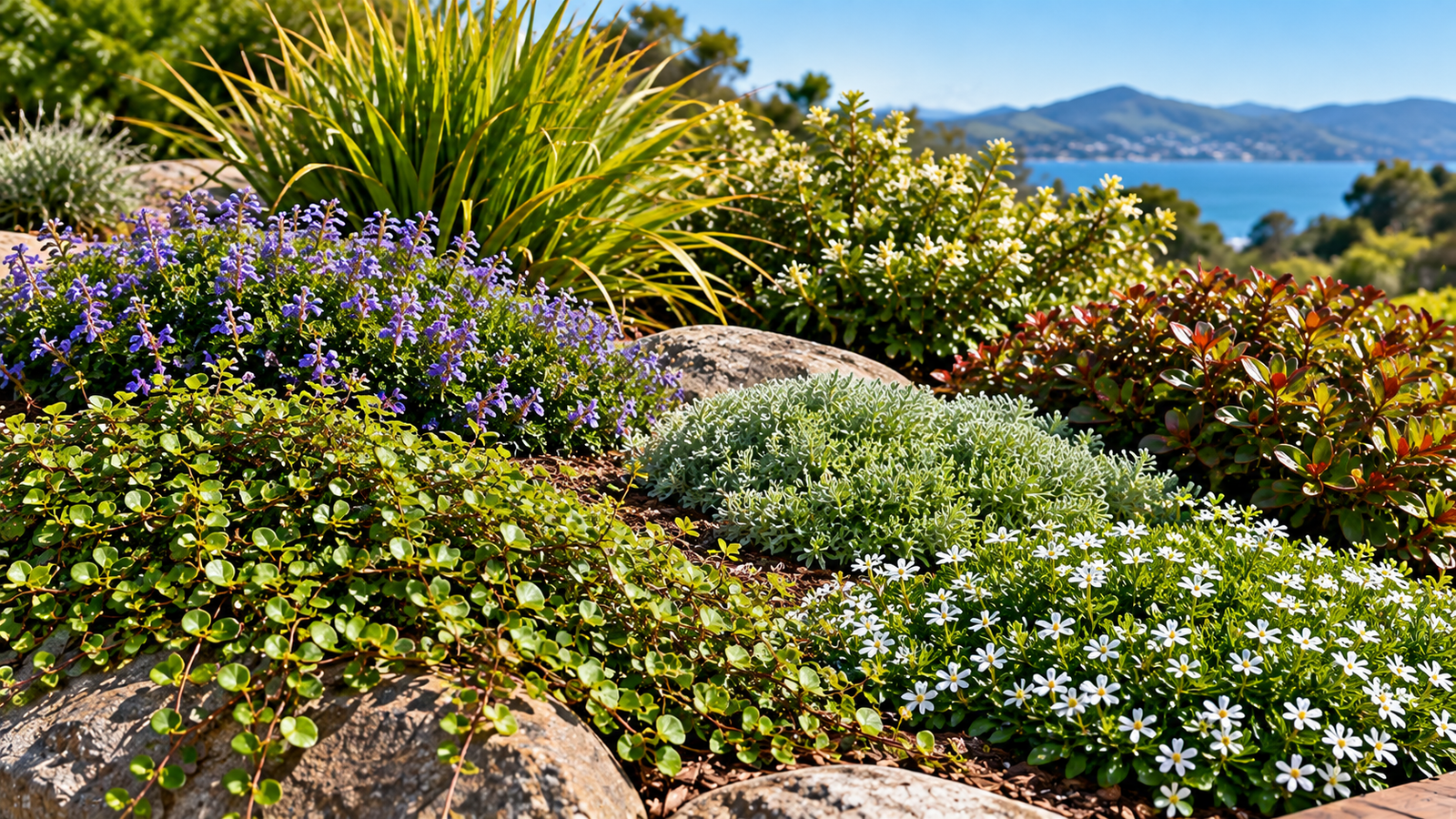
Choosing the best ground cover plants NZ gardeners can grow starts with matching the right plant to the conditions in your garden.
Ground covers can turn bare soil into a greener, more finished and lower-maintenance part of the landscape. The right plants can soften garden edges, cover banks, fill awkward gaps between shrubs and help reduce the amount of exposed soil where weeds can establish.
New Zealand gardens range from damp, shaded sites to dry coastal slopes, so a plant that thrives in one location may struggle badly in another.
This guide compares 15 ground cover plants for New Zealand gardens, including native and non-native options for sun, shade, slopes, coastal conditions, pathways and difficult spaces.
For gardeners searching for ground cover plants NZ conditions can support, Muehlenbeckia axillaris is an excellent native starting point for sunny or exposed areas. For moist partial shade, consider Pratia angulata; for coastal gardens, Pimelea prostrata; and for dry sunny areas, creeping thyme is a useful non-native option.
The best choice ultimately depends on sunlight, drainage, soil moisture, exposure and how much foot traffic the area receives.
15 Best Ground Cover Plants NZ Gardeners Can Grow
If you’re shortlisting plants, start here. This table gives you a quick overview of the growing conditions and situations each option is best suited to.
| Plant | Light | Native? | Best for |
|---|---|---|---|
| Muehlenbeckia axillaris | Sun–part shade | Yes | Dry, exposed sites |
| Pratia angulata | Part shade | Yes | Moist shade |
| Pimelea prostrata | Sun–part shade | Yes | Coastal gardens |
| Coprosma kirkii | Sun–part shade | Yes | Banks and large areas |
| Acaena novae-zelandiae | Sun–part shade | Yes | Naturalistic planting |
| Scleranthus uniflorus | Sun–part shade | Yes | Rock gardens |
| Selliera radicans | Sun–part shade | Yes | Low mat planting |
| Hebe ‘First Light’ | Sun–part shade | NZ cultivar | Borders and rockeries |
| Dichondra repens | Sun–part shade | Yes | Between pavers |
| Creeping thyme | Full sun | No | Dry sites |
| Ajuga reptans | Part shade–shade | No | Shady borders |
| Chamomile | Sun | No | Informal paths |
| Blue star creeper | Sun–part shade | No | Low-growing coverage |
| Kidney weed | Sun–part shade | Yes | Lawn alternative |
| Prostrate rosemary | Full sun | No | Dry banks and walls |
Native Ground Cover Plants for New Zealand Gardens
Some of the most useful ground cover plants NZ gardeners can choose are native species that naturally stay low, spread across exposed ground or form dense mats.
If you’re planning a broader native garden, see our guide to the best native plants for New Zealand gardens.
1. Muehlenbeckia axillaris — Creeping Wire Vine
Best for: sunny sites, rock gardens, walls and exposed areas.
Muehlenbeckia axillaris is one of the most useful native ground covers for difficult NZ garden sites. Small leaves grow along wiry stems that spread across the ground, rocks and garden edges.
Once established, it can cope with relatively dry periods and exposed conditions, making it particularly useful where softer ground covers struggle.
Its fine texture also fits beautifully into contemporary gardens, rockeries and native planting schemes.
2. Pratia angulata — Panakenake
Best for: moist, partly shaded areas.
If your difficult area is damp rather than dry, Pratia angulata is a much better candidate.
This native forms a low carpet of small green leaves and delicate flowers. It performs particularly well in fertile, moisture-retentive soil with filtered light or partial shade.
It’s useful beneath taller planting and around damp borders where a sun-loving ground cover would struggle.
3. Pimelea prostrata — Pinatoro / NZ Daphne
Best for: coastal gardens, exposed sites and free-draining soil.
Pimelea prostrata combines low-growing foliage with small flowers and useful tolerance of exposed conditions.
It can be particularly attractive in coastal-style gardens, where wind and relatively dry conditions can rule out more delicate plants.
Give it good drainage and a position in sun or partial shade.
4. Coprosma kirkii
Best for: slopes, banks and covering larger areas.
Coprosma kirkii has a spreading habit that makes it useful where you have more ground to cover.
Its foliage can soften retaining walls and banks while reducing the amount of exposed soil. It also works well where you want year-round structure rather than relying entirely on seasonal flowers.
5. Acaena novae-zelandiae — Bidibid
Best for: informal and naturalistic planting.
Acaena novae-zelandiae forms a spreading mat and works particularly well when you want a more natural appearance rather than a manicured carpet.
Its foliage adds texture around rocks and between larger native plants.
One consideration is the burr-like seed heads, so think carefully about placement if people or pets regularly brush past the area.
6. Scleranthus uniflorus
Best for: rock gardens and architectural planting.
Scleranthus uniflorus creates dense cushion-like mounds of fine green foliage.
Rather than rapidly swallowing a large area, it’s particularly valuable where appearance and texture matter. It looks striking around stone, gravel and contemporary hard landscaping.
7. Selliera radicans — Remuremu
Best for: very low mat-style planting.
Selliera radicans is a native creeping plant capable of forming dense mats close to the ground.
It naturally occurs in coastal and damp environments, making it an interesting option for landscapes inspired by New Zealand’s natural planting communities.
8. Hebe ‘First Light’
Best for: borders, rockeries and colourful native-style planting.
Not every ground cover needs to hug the soil. Low, spreading Hebe cultivars can fill the space between traditional ground covers and small shrubs.
They’re particularly useful when you want greater structure and seasonal flower interest.
9. Dichondra repens — Kidney Weed
Best for: between pavers and lawn-like coverage.
Despite the less-than-glamorous common name, Dichondra repens can create an attractive carpet of small rounded leaves.
Its very low habit makes it useful around stepping stones and in places where taller ground covers would look untidy.
Other Excellent Ground Cover Plants
Native plants aren’t the only useful choice. Introduced species can perform extremely well when their growing requirements match the site.
10. Creeping Thyme
Best for: sunny, dry and free-draining areas.
Creeping thyme is a classic option for gardeners wanting low foliage, flowers and fragrance.
It loves sun and dislikes sitting in persistently wet soil, making it particularly useful around stones, sunny edges and dry garden areas.
11. Ajuga reptans
Best for: shady borders.
Ajuga is useful where sun-loving plants fail. It forms spreading rosettes of foliage and produces colourful flower spikes.
Different cultivars can provide green, bronze, purple or variegated foliage, adding contrast beneath taller planting.
12. Chamomile
Best for: sunny informal gardens and lightly used paths.
Low-growing chamomile creates a softer alternative to conventional ground covers, with aromatic foliage and daisy-like flowers.
It works particularly well in cottage-style planting and around informal pathways.
13. Blue Star Creeper
Best for: small gaps and low-growing coverage.
Blue star creeper creates a very low carpet dotted with small flowers during its flowering season.
Its compact habit can look particularly attractive around stepping stones and at the front of garden beds.
14. Ornamental Dichondra Cultivars
Best for: decorative low foliage.
Beyond green Dichondra repens, ornamental Dichondra selections can provide attractive cascading foliage over garden edges.
They’re especially useful where foliage texture matters more than masses of flowers.
15. Prostrate Rosemary
Best for: dry sunny banks, walls and Mediterranean-style gardens.
Prostrate forms of rosemary suit hot, sunny and well-drained positions. Their stems spread outward and can cascade attractively over retaining walls.
Avoid poorly drained soil. Rosemary generally prefers drier roots to persistently wet conditions.
Best Ground Cover Plants for Full Sun in NZ
Full-sun areas often dry more quickly, so plants need to cope with both direct sunlight and fluctuating soil moisture.
Tough native option for exposed sunny areas, rockeries and edges.
A strong candidate for sunny, free-draining and coastal conditions.
Excellent for dry, sunny sites where drainage is good.
Useful for warm banks and walls where the soil doesn’t stay wet.
Best Ground Cover Plants for Shade in NZ
Shady areas require a different approach. A plant adapted to open coastal sun may become sparse beneath trees or on the shaded side of a building.
One of the better native choices for moist partial shade.
Useful beneath taller planting where colourful foliage is wanted.
Low-growing option for appropriate partly shaded sites.
Can handle some partial shade where reasonable filtered light remains.
Deep, dry shade is particularly difficult because plants must cope with low light and competition for moisture from nearby roots. A label saying “shade tolerant” does not automatically mean the plant will thrive in completely dark, dry soil.
Best Ground Cover Plants for Banks and Slopes
Banks present their own challenge. Exposed soil can dry quickly and may erode before plants become established.
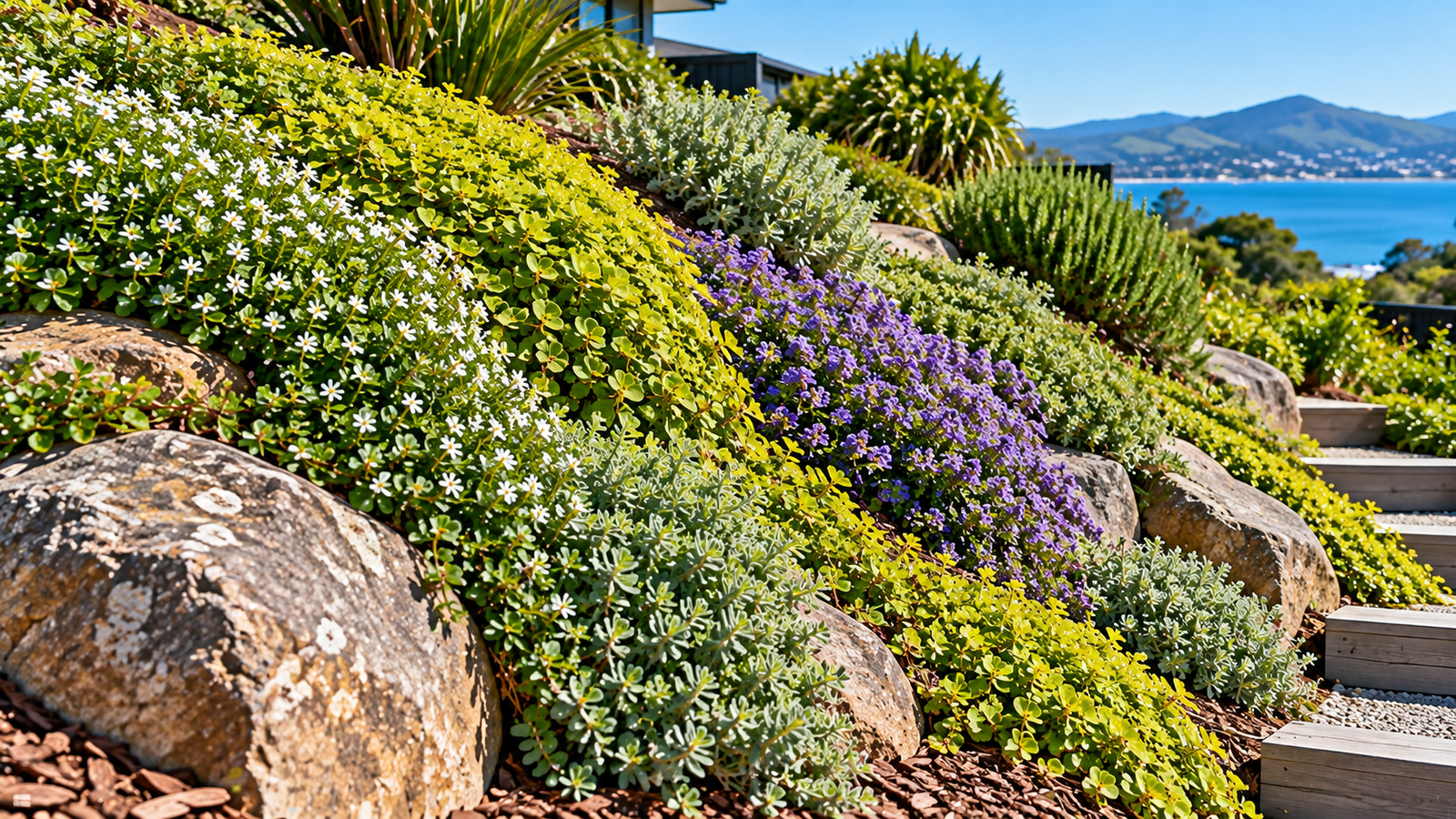
Spreading plants such as Coprosma kirkii and Muehlenbeckia axillaris can be useful candidates, while Pimelea prostrata deserves consideration for sunny, exposed and coastal situations.
Ground Cover Plants Between Pavers
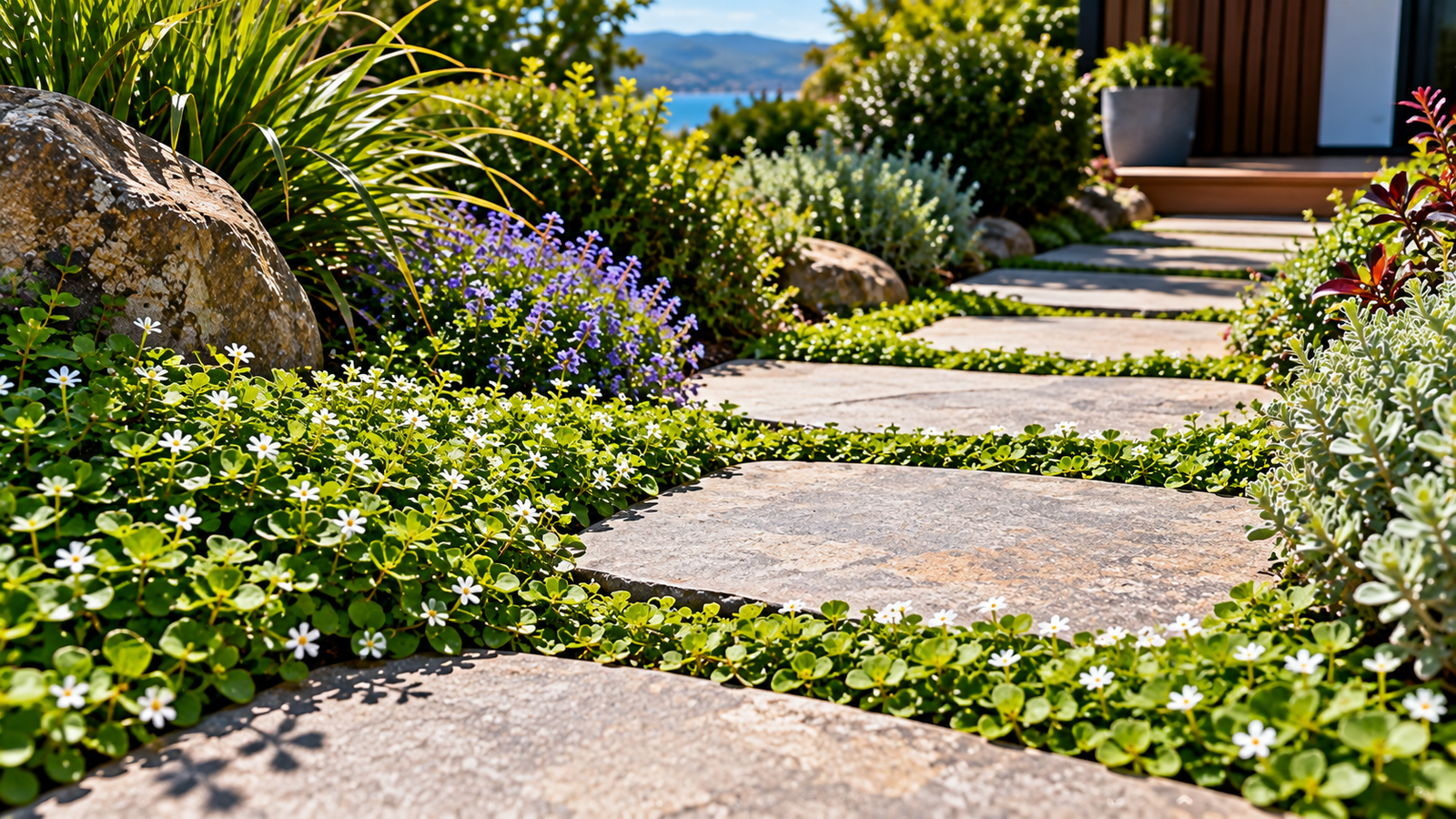
Low-growing plants can soften hard landscaping and turn the gaps between stepping stones into part of the garden rather than leaving them as bare soil or gravel.
Dichondra repens is particularly useful for this style of planting, while Pratia can look beautiful where moisture and light conditions suit it.
Do Ground Cover Plants Stop Weeds?
Ground covers can reduce weed pressure, but they won’t magically eliminate weeds.
Once dense foliage covers the soil, there is less light and open space available for new weeds to establish. The difficult period is while the new plants are still filling the gaps.
Clear difficult weeds before planting rather than trying to untangle them from established ground cover later.
Correct major compaction or drainage issues before the area becomes covered.
Give plants enough room to mature without leaving unnecessarily large gaps.
Mulch can suppress weeds and conserve moisture while the plants establish.
Remove new weeds before they become intertwined with your ground cover.
How to Plant Ground Cover Plants
Start with sunlight, drainage, soil moisture and exposure. These factors matter more than choosing whichever plant looks best at the nursery.
Remove perennial weeds before planting. It becomes considerably harder once spreading plants have filled the area.
Compacted soil may benefit from organic matter, but species adapted to lean, free-draining sites do not necessarily need rich soil.
Position the plant at approximately the same soil level it was growing at in its container.
Even drought-tolerant plants need adequate moisture while their root systems establish.
Mulch helps retain moisture and suppress weeds until the ground cover closes the gaps.
How Far Apart Should Ground Cover Plants Be?
There is no universal spacing because mature spread varies enormously between species and cultivars.
Creates faster coverage and suppresses bare soil sooner, but increases the initial cost.
Costs less initially, but leaves bare ground exposed for longer and requires more weed management.
Check the expected mature width of the exact plant you’re purchasing rather than relying on a generic ground-cover spacing rule.
How to Choose the Right Ground Cover
When comparing ground cover plants NZ gardeners have available, the easiest way to narrow the options is to start with the conditions in your garden rather than a particular plant name.
| Your garden conditions | Good starting options |
|---|---|
| Sunny and dry | Muehlenbeckia, creeping thyme, prostrate rosemary |
| Moist partial shade | Pratia angulata, Ajuga |
| Coastal or exposed | Pimelea prostrata, Muehlenbeckia |
| Bank or slope | Coprosma kirkii, Muehlenbeckia |
| Between pavers | Dichondra repens, Pratia where conditions suit |
| Native garden | Coprosma, Pimelea, Muehlenbeckia, Pratia |
| Rock garden | Scleranthus, creeping thyme, low Hebe |
For additional information about native species and local growing conditions, see the New Zealand Department of Conservation native plant resources and the Auckland Botanic Gardens gardening advice. Local climate, soil and exposure can make a significant difference to how a plant performs.
Frequently Asked Questions
What is the best ground cover plant in New Zealand?
There isn’t one best choice for every NZ garden. Muehlenbeckia axillaris is a tough native option for sunny and exposed sites, Pratia angulata is better suited to moist partial shade, while Pimelea prostrata is a useful candidate for coastal conditions.
What is a fast-growing ground cover in NZ?
Several spreading plants can fill an area relatively quickly when conditions suit them, including Pratia, Muehlenbeckia and some Coprosma selections. Actual growth rate depends on climate, soil, moisture and planting density.
What ground cover grows well in shade?
Pratia angulata is a useful native option for moist partial shade. Ajuga and Dichondra can also perform in lower-light situations when their soil and moisture requirements are met.
What ground cover is good for a sunny bank?
Coprosma kirkii, Muehlenbeckia axillaris and Pimelea prostrata are all worth considering for suitable sunny banks. Drainage, exposure and your local climate should guide the final choice.
Are native ground covers low maintenance?
Many can become relatively low maintenance once established in suitable conditions. However, being native does not mean a plant will thrive in every New Zealand garden without care.
When should I plant ground cover in NZ?
Autumn is often a useful planting period for many ground covers because cooler temperatures and increased soil moisture can reduce establishment stress. Your region, local conditions and the particular species should still guide the final timing.
Can ground cover plants replace a lawn?
Some very low-growing species can replace conventional lawn in areas with little foot traffic, but most won’t tolerate the same repeated wear as turf. Consider how frequently the area is actually walked on before replacing grass.
Final Thoughts
The best ground cover plants NZ gardens can support are not necessarily the fastest-growing or most colourful options — they’re the plants best matched to the conditions you already have.
For exposed and sunny areas, tough natives such as Muehlenbeckia and Pimelea are excellent places to start. For damp partial shade, Pratia offers a completely different solution. Banks may benefit from spreading Coprosma, while small sunny gaps can suit creeping thyme and other compact plants.
Check sunlight, drainage, soil moisture, mature spread and local climate first. Get those factors right and an awkward patch of bare soil can become one of the most attractive — and easiest — parts of your garden to maintain.
Related Articles
1 Comment
[…] For other seasonal projects, see our guide to native plants for New Zealand gardens and our ground cover plant ideas. […]