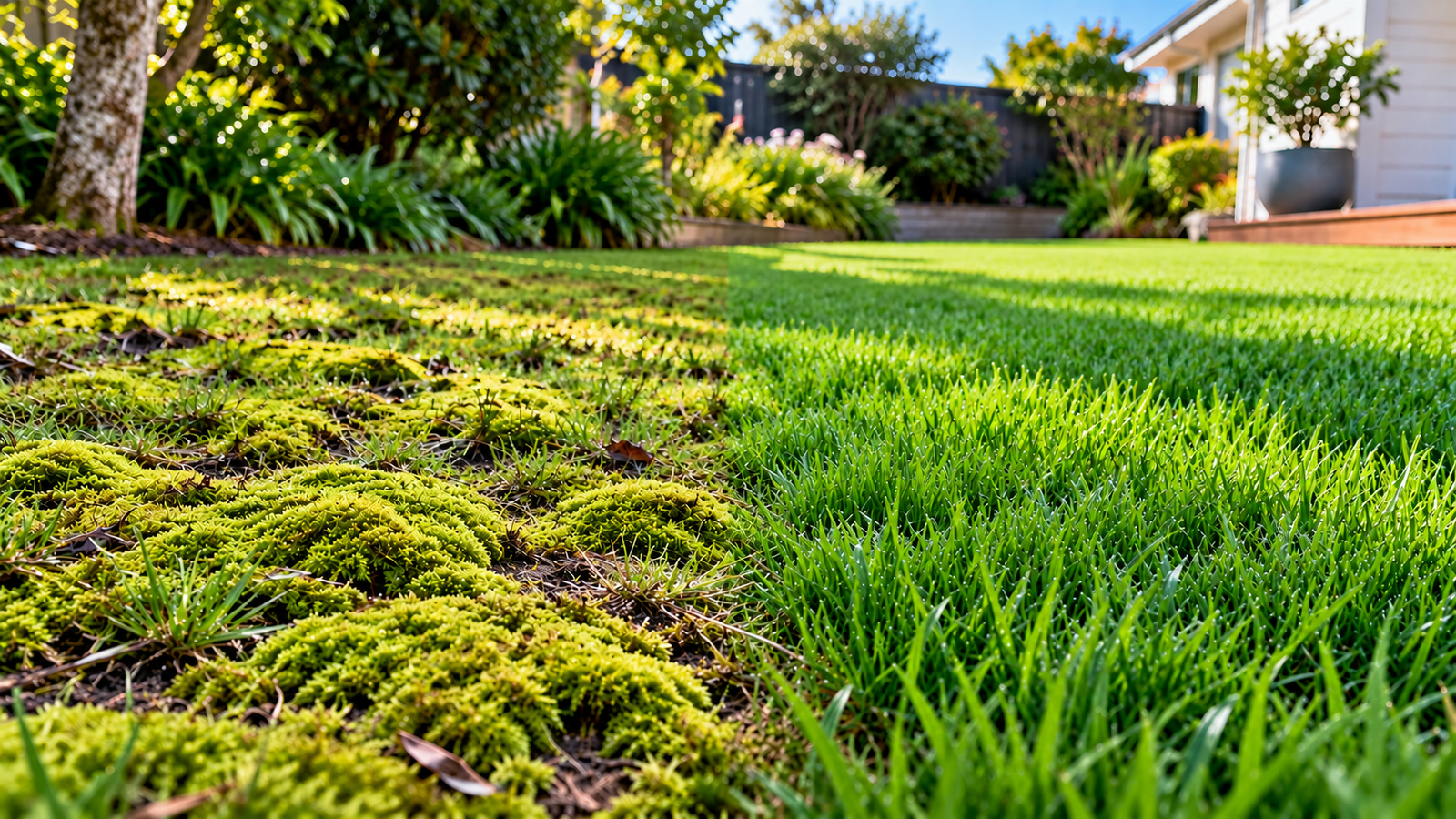
If you’re wondering how to get rid of moss in lawn NZ, the answer goes beyond simply adding a moss killer. Moss usually appears because the grass is struggling with shade, excess moisture, compacted soil, poor drainage or low fertility.
You can kill the visible moss, but if those conditions remain unchanged, there’s a good chance you’ll be dealing with another green, spongy patch later.
In this guide, you’ll learn why moss grows, how to remove it, how to repair your lawn and, most importantly, how to stop it coming back.
How do you get rid of moss in a NZ lawn?
Treat or remove the existing moss, rake out the dead material, then fix the conditions that allowed it to thrive. That may mean aerating compacted soil, improving drainage, reducing shade, correcting lawn nutrition and reseeding bare areas.
- Kill or remove the existing moss.
- Rake out dead moss.
- Aerate compacted soil.
- Improve drainage where necessary.
- Reduce shade where possible.
- Repair bare patches with suitable grass seed.
- Maintain healthy turf to make it harder for moss to return.
Why is moss growing in your lawn?
Moss itself isn’t usually the original problem. Think of it as a clue that conditions are favouring moss more than healthy turf.
In New Zealand lawns, several conditions can contribute to moss growth, including poor drainage, heavy or wet soil, shade, compaction, insufficient lawn nutrition and prolonged damp conditions.
When grass becomes thin or stressed, it leaves open spaces where moss can establish and spread.
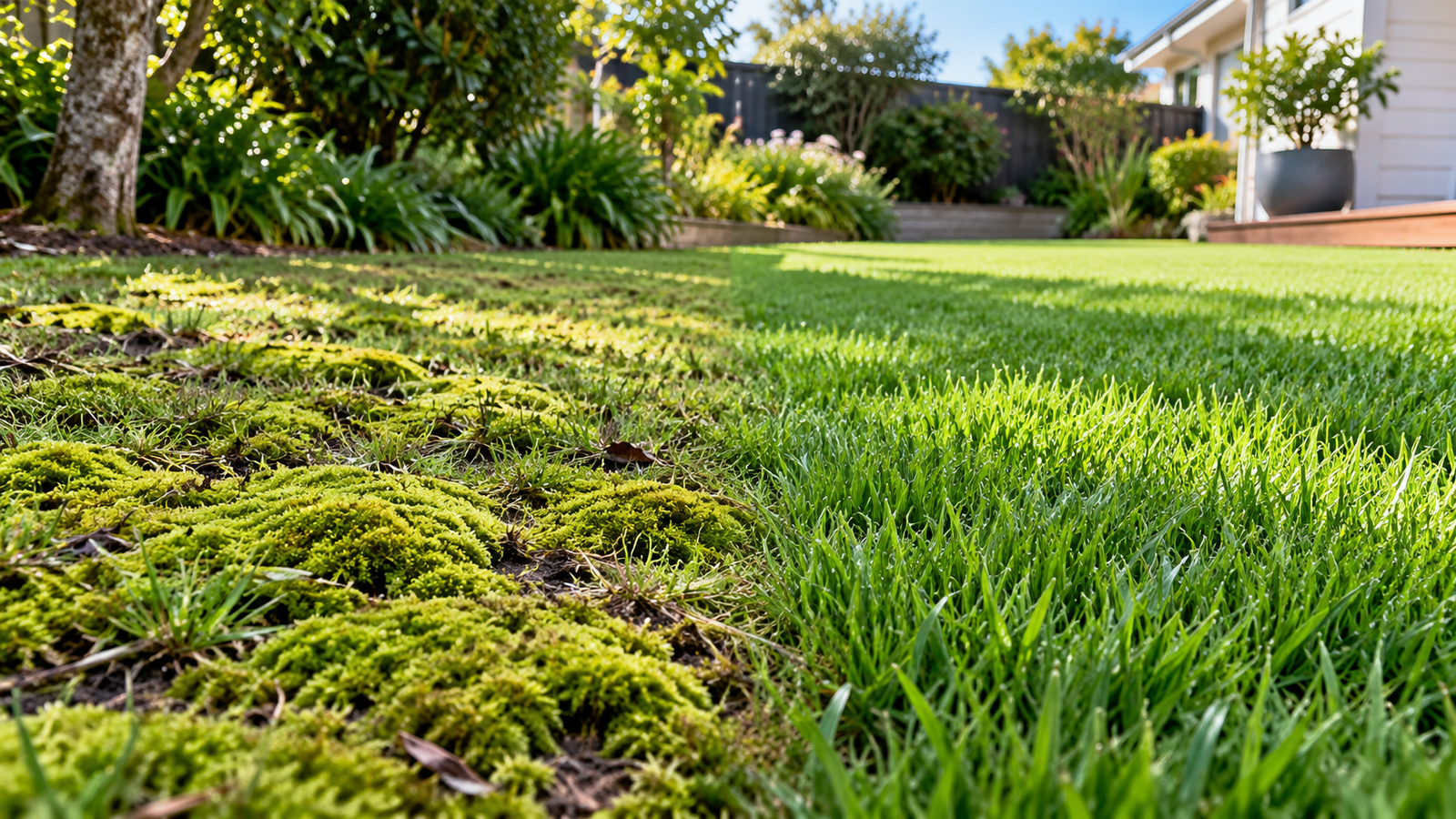
Water remains near the surface after rain and the lawn takes a long time to dry.
Grass remains thin beneath trees, fences or on a shaded side of the house.
Heavy traffic compresses the soil, reducing air spaces and potentially slowing drainage.
Thin or poorly growing grass leaves more open space for moss to establish.
First, work out why the moss is there
Before applying anything, inspect the affected part of your lawn. Where and when the moss appears can give you useful clues about the underlying problem.
| What you notice | Possible issue | What to investigate |
|---|---|---|
| Water sits after rain | Poor drainage | Soil structure, slope, runoff and drainage |
| Ground feels very hard | Compaction | Aeration and heavy foot traffic |
| Moss mainly beneath trees | Shade and moisture | Light levels and airflow |
| Grass is thin across the area | Weak turf growth | Nutrition, mowing, soil and grass condition |
| Heavy, sticky soil when wet | Clay soil | Structure, compaction and drainage |
If water regularly remains on the surface, see our Garden Drainage NZ guide. If you’re dealing with dense clay, our Clay Soil NZ guide explains how to improve heavy garden soil.
How to get rid of moss in your lawn: step by step
For an established moss problem, think of recovery as a process rather than a single application.
-
Deal with the existing moss.
For significant infestations, use a lawn moss treatment suitable for your lawn and follow the product label exactly. Light infestations may also be physically removed as part of lawn renovation. -
Allow the treatment to work.
Depending on the product used, treated moss may darken as it dies. Follow the manufacturer’s directions regarding timing before further lawn work. -
Rake out the dead material.
Removing dead moss opens the surface and exposes areas that need repair. -
Aerate compacted soil.
Pay particular attention to high-traffic areas and sections that remain wet longer than the rest of the lawn. -
Correct the underlying problem.
Improve drainage, address excessive shade where practical and support healthy grass growth. -
Overseed bare patches.
Don’t leave large areas of exposed soil for moss and weeds to recolonise. -
Maintain dense turf.
Appropriate mowing, feeding, watering and seasonal care can help the grass compete more effectively.
Should you use a moss killer for lawns?
A dedicated moss killer for lawns can be useful when moss is widespread, but it should be viewed as one part of the solution rather than the entire solution.
Iron-based lawn treatments are commonly used for moss control. Some formulations combine moss control with lawn fertiliser, while others are dedicated moss treatments.
Always follow the directions for the specific product you buy. Application rates, watering instructions, restrictions and precautions vary between formulations.
Don’t assume an ordinary broadleaf lawn weedkiller will automatically control moss. If chemical treatment is part of your plan, choose a product specifically labelled for moss control.
Why you should rake out dead moss
Killing moss isn’t the same as restoring your lawn.
Once the moss has died, rake the affected area to remove the dead material. For larger areas, this process is often referred to as scarifying.
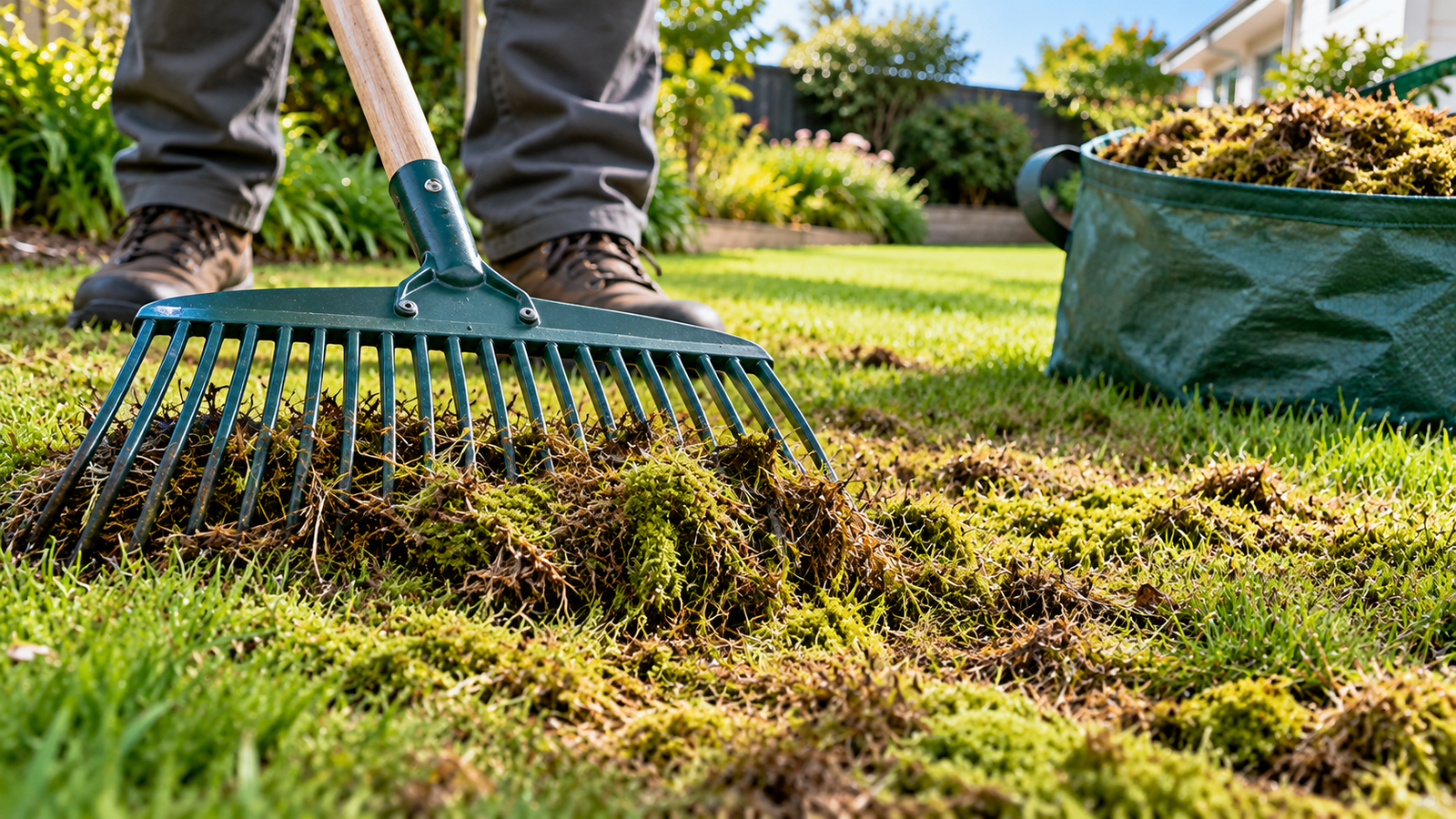
Don’t be alarmed if the lawn temporarily looks worse. A heavy infestation may have been occupying areas where very little healthy grass remained underneath.
Removing that material gives you a clearer surface to work with during the recovery stage.
Aerate compacted lawn areas
Compaction can contribute to several lawn problems at once. Dense soil can restrict air around grass roots, reduce healthy root development and contribute to poor water movement.
For small home lawns, a garden fork can help open compacted areas. Larger lawns may justify dedicated spike or core-aeration equipment.
Pay particular attention to:
- routes people regularly walk across;
- areas beside driveways and paths;
- sections where children or pets frequently play;
- ground that remains wet longer than surrounding turf;
- soil that feels unusually hard when you try to push a fork into it.
Aeration isn’t a cure for every drainage problem, but it can be useful where surface compaction is contributing to poor lawn conditions.
Fix poor drainage or the moss may return
This is one of the most important parts of long-term lawn moss treatment.
If water regularly pools after rain, simply killing the moss leaves the conditions that helped it establish largely unchanged.
Start by identifying where the water is coming from and why it isn’t moving away. Is the soil compacted? Is runoff flowing toward the lawn? Is the site low-lying? Is dense clay slowing infiltration?
Minor surface compaction may improve with aeration and better soil management. Persistent waterlogging can require more substantial drainage work.
What if the lawn is simply too shady?
Moss often thrives where grass receives limited light and the soil remains damp for longer.
If trees or dense shrubs are creating the problem, selective pruning may improve light and airflow where appropriate. But some locations are naturally poor sites for conventional lawn.
A persistently shaded strip beside a building, for example, may be better suited to another landscape treatment than an endless cycle of reseeding grass and removing moss.
Sometimes the long-term solution is recognising that turf isn’t the best plant for a particular part of the garden.
Does soil pH cause lawn moss?
You may hear that moss automatically means your soil is acidic. Treat that as a possibility rather than a diagnosis.
Moss can occur alongside acidic conditions, but shade, excess moisture, compaction and weak grass growth can also contribute.
Don’t apply lime simply because moss is present. If you suspect a soil-pH issue, testing the soil provides better information than guessing.
Repair the lawn after removing moss
After a significant infestation, the lawn can look thin or patchy once the dead moss has been removed. That’s normal.
The next objective is to establish grass in those gaps before moss or weeds reclaim them.
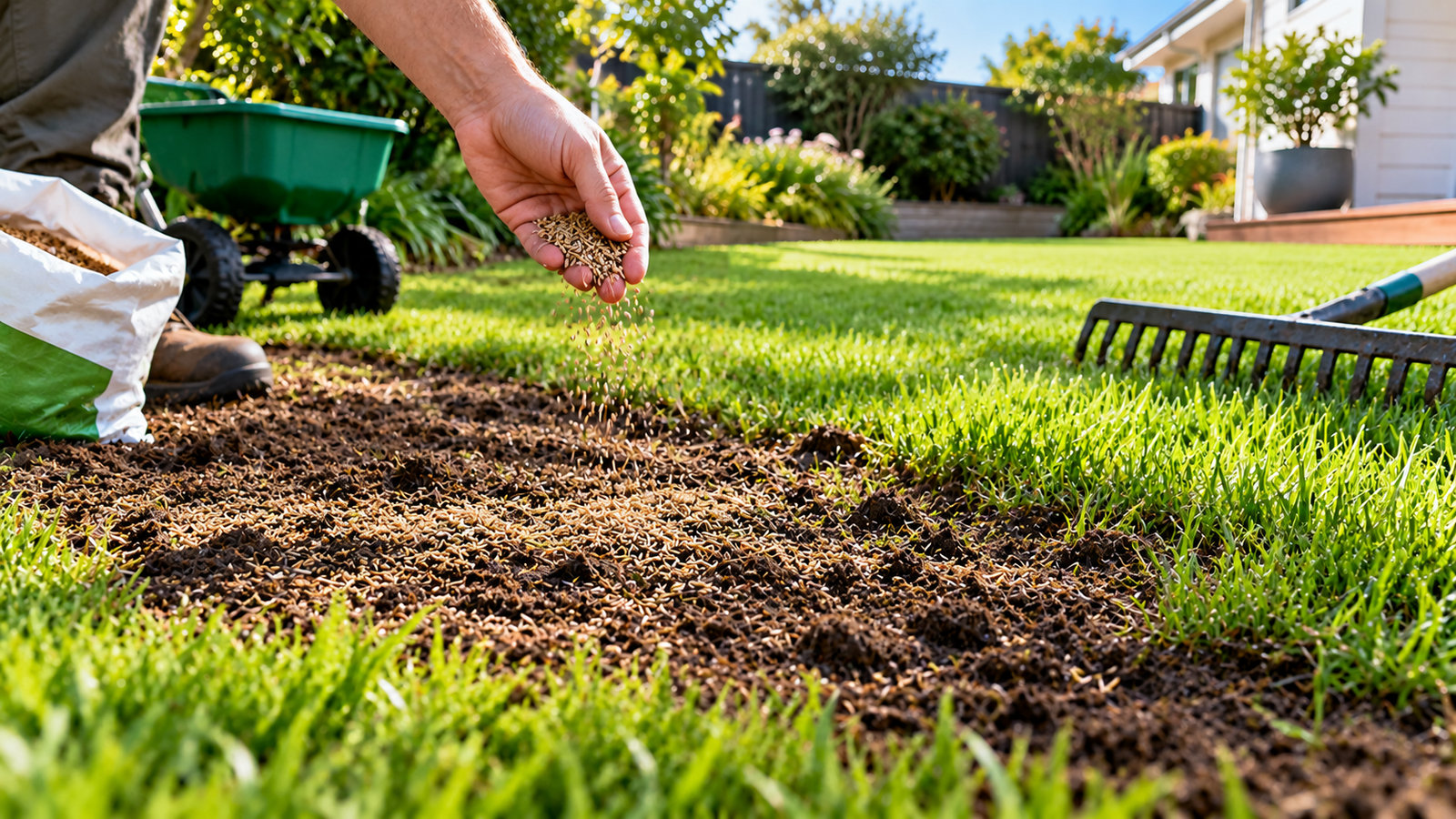
For bare patches:
- remove loose dead moss and debris;
- lightly prepare the soil surface;
- use lawn seed suited to your conditions and existing lawn;
- keep newly seeded areas appropriately moist during establishment;
- limit heavy traffic while the new grass develops.
In persistently shaded areas, consider whether a grass type suited to lower-light conditions is appropriate — or whether maintaining turf in that location is realistic at all.
When is the best time to treat lawn moss in NZ?
Spring and autumn can be useful periods for lawn renovation because conditions often support active grass growth in many parts of New Zealand.
However, the correct timing for a specific moss-control product depends on its label, local weather and the condition of your lawn.
If moss removal will leave large bare patches, plan for the repair stage as well. Removing moss when conditions are poor for grass establishment can leave exposed ground bare for longer.
How to stop moss coming back
The best long-term defence is a healthy lawn growing in conditions that favour grass rather than moss.
- Improve drainage: investigate areas that remain saturated.
- Reduce compaction: aerate problem areas and manage heavy traffic.
- Manage shade: improve light and airflow where practical.
- Feed appropriately: support healthy, competitive turf.
- Repair bare areas: don’t leave large gaps after moss removal.
- Avoid unnecessarily short mowing: repeatedly scalping a weak lawn can make recovery harder.
- Review watering: avoid adding unnecessary moisture to soil that is already wet.
The goal isn’t to make your garden hostile to every trace of moss. It’s to make the lawn healthy enough that moss no longer has an easy opportunity to dominate.
Root & Yard verdict
If you want to know how to get rid of moss in lawn NZ, remember one simple rule: remove the moss and remove its advantage.
A moss killer can deal with the visible infestation, but lasting improvement usually comes from what happens afterwards — raking, aerating, fixing drainage or shade problems, repairing bare patches and encouraging dense, healthy grass.
If you’re treating the same patch every year without changing the conditions, the moss may be telling you something important about that part of your garden.
Frequently asked questions
What kills moss in lawns in New Zealand?
Dedicated lawn moss treatments are available in New Zealand, including iron-based products. Choose a product specifically labelled for lawn moss and follow its directions and precautions.
Why does moss keep coming back after I kill it?
The conditions favouring moss may still be present. Poor drainage, shade, compacted soil, persistent moisture and weak turf can all encourage it to re-establish.
Should I rake moss out of my lawn?
Once dead, removing the moss by raking or scarifying clears the surface and exposes areas that may need aeration, soil improvement or reseeding.
Does aerating a lawn help with moss?
It can help where compaction and poor surface drainage are contributing factors. Severe drainage problems may require additional work beyond aeration.
Does moss mean my soil needs lime?
Not necessarily. Moss can occur in acidic conditions, but shade, moisture, compaction and weak lawn growth can also contribute. Test soil pH rather than applying lime based on moss alone.
What should I do with bare lawn after removing moss?
Prepare the exposed soil and overseed it with an appropriate lawn seed when growing conditions are suitable. Establishing dense grass helps reduce open space available to moss and weeds.
What is the best time of year to remove moss from a NZ lawn?
Spring and autumn can be useful periods for lawn repair and moss management because conditions often support grass growth. Always consider local weather and the instructions of any treatment you use.
Fix what’s causing the moss
If your lawn remains wet after rain, continue with our Garden Drainage NZ guide. If dense, sticky soil is contributing to the problem, see our Clay Soil NZ guide.
Tui Garden — New Zealand guidance on moss in lawns, including contributing conditions, treatment and lawn care.
Kiwicare — New Zealand guidance on lawn moss identification, treatment and lawn restoration.
Yates New Zealand — lawn-care and moss-control guidance, including iron-based lawn treatments.
Related Articles


1 Comment
[…] is particularly relevant after removing a heavy moss infestation. In our guide to getting rid of moss in a NZ lawn, we explain how to remove moss, correct the conditions behind it and repair bare […]