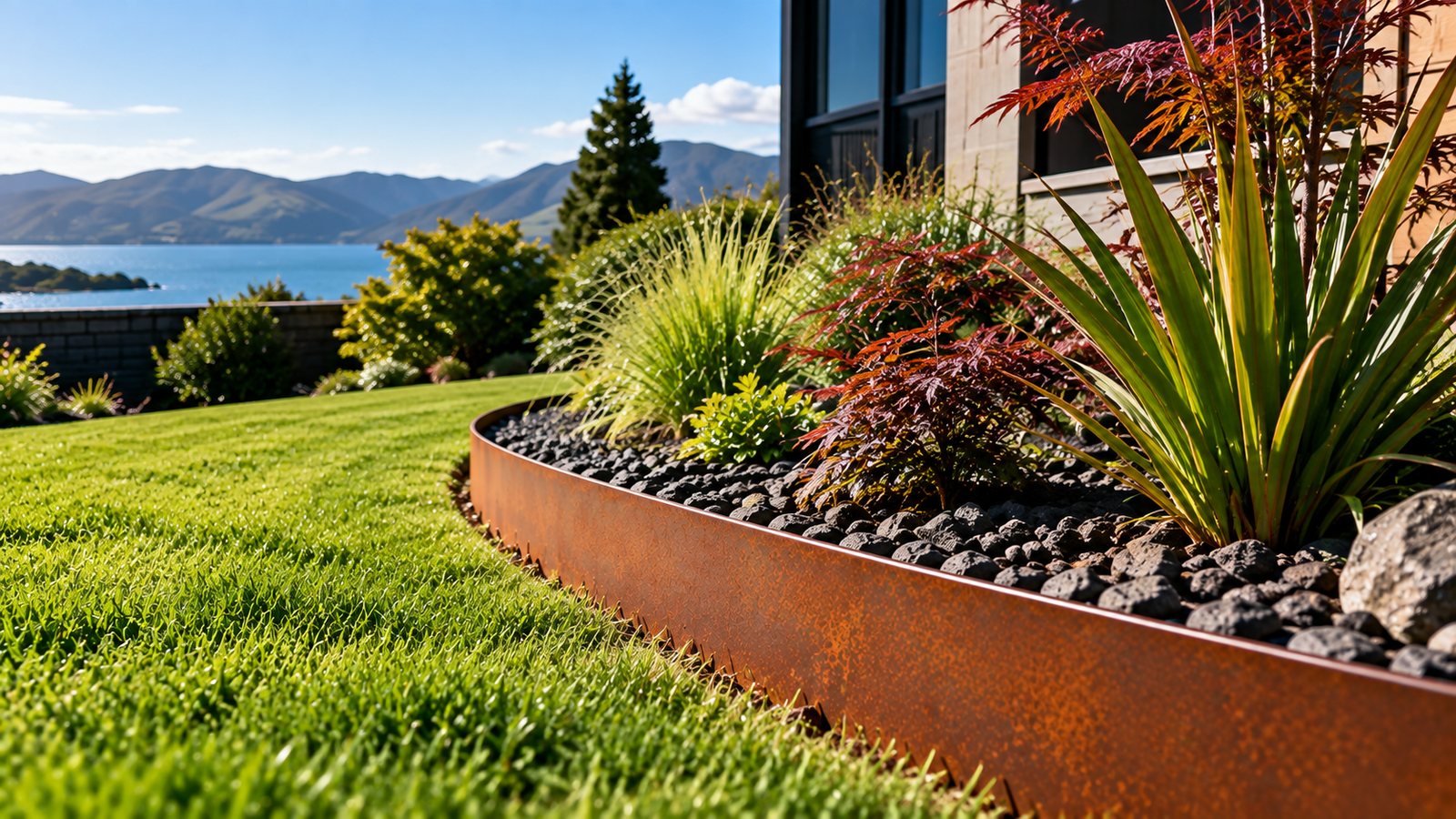
Steel garden edging is a strong option for New Zealand gardens when you want crisp lawn lines, neat planting beds and a border that feels more permanent than plastic. It can be subtle and almost disappear into the landscape, or become a visible design feature when you choose weathering steel.
The main decision is not simply “steel or no steel”. You need to choose between galvanised or powder-coated steel, weathering steel such as Corten, and systems designed for straight lines, curves or both. Height, thickness, fixing method and soil conditions also affect how well the finished edge performs.
In this guide
- Why choose steel garden edging?
- Types of steel edging in NZ
- Corten vs galvanised steel
- How much does steel garden edging cost in NZ?
- What height should you choose?
- Straight runs vs curved gardens
- How to install steel garden edging
- Best uses around the garden
- Steel vs timber edging
- Common mistakes
- Maintenance and lifespan
- FAQ
If you are still comparing steel with timber, plastic, stone or concrete, start with our complete guide to garden edging in New Zealand. This page focuses specifically on steel.
Why choose steel garden edging?
Steel suits gardens where you want a defined edge without a bulky border. A relatively thin strip can separate turf from planting beds, gravel or mulch while keeping the visual line clean.
- Creates sharp, tidy lawn and garden-bed boundaries.
- Available in profiles for both curves and straight lines.
- Uses less visual space than many timber, stone or concrete borders.
- Can work in modern, formal and naturalistic garden designs.
- Weathering steel can be used as a deliberate decorative feature.
Types of steel garden edging available in NZ
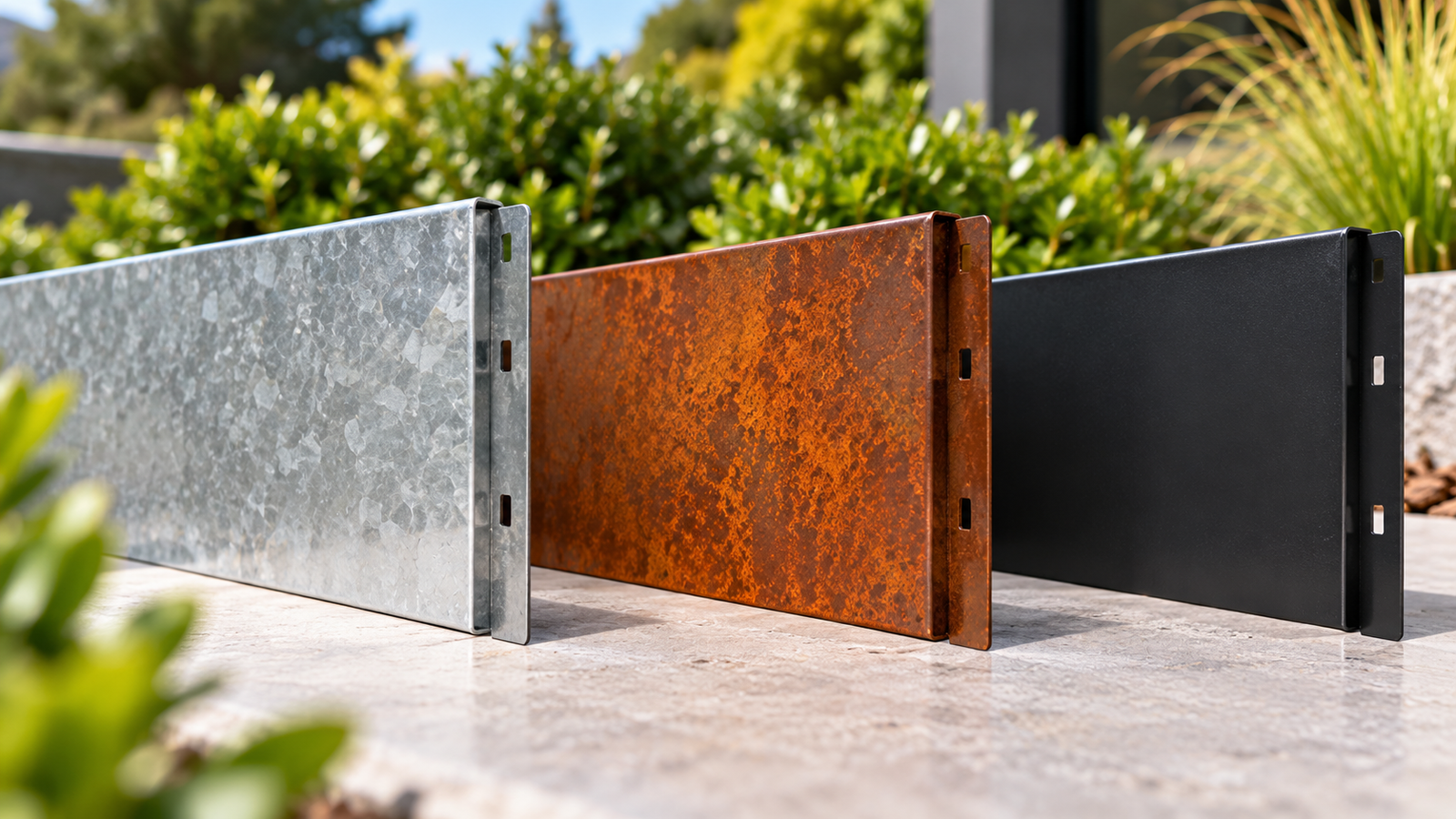
Galvanised steel
A zinc-coated steel designed to improve corrosion resistance. It is a practical choice when you want a clean edge without making the border a major visual feature.
Powder-coated steel
Usually chosen for a more finished appearance. Dark brown or black edging can visually recede beside soil, bark or lawn.
Weathering / Corten steel
Designed to develop a stable weathered surface. The orange-brown patina makes the edging more visible and works particularly well in contemporary landscaping.
Rigid steel profiles
Thicker or reinforced sections are useful where a very straight line matters. Some rigid profiles are not intended to curve, so check the product specification before buying.
Corten vs galvanised steel garden edging
| Feature | Galvanised / coated steel | Weathering / Corten steel |
|---|---|---|
| Appearance | Usually neutral, dark or metallic | Develops a distinctive rust-coloured patina |
| Best for | Subtle lawn and bed boundaries | Visible landscape features and contemporary gardens |
| Price | Often lower, depending on system and finish | Often carries a premium |
| Curves | Many flexible systems are available | Available in flexible and rigid versions |
| Finish over time | Intended to retain its coated or galvanised finish | Intended to change visually as the patina develops |
How much does steel garden edging cost in New Zealand?
There is no useful single “NZ price” because products vary in length, height, thickness, coating and joining system. Comparing the cost per metre is more useful than comparing the sticker price per piece.
As a snapshot checked in September 2026, Bunnings NZ listed a Jack galvanised steel interlock panel measuring 1.18 m × 130 mm at NZ$19.99. EverEdge NZ listed its 1 m galvanised and powder-coated Classic edging from NZ$26.45 per metre, while its 1 m Cor-Ten option was NZ$40.25 per metre. Tiny Anvil listed curvable 2 m Corten edging from NZ$45, with price increasing for taller and rigid versions.
What height should steel garden edging be?
The right height depends on what the edging is actually doing. A low lawn separator needs much less exposed material than a border intended to retain mulch or create a visible raised line.
| Use | What to look for | Why |
|---|---|---|
| Lawn separator | Low-profile edging with enough below-ground fixing | Keeps the border tidy without creating a trip point |
| Mulched bed | A slightly taller visible edge | Helps keep bark or mulch contained |
| Gravel path | Enough exposed height to separate gravel from soil or lawn | Reduces material migration across the boundary |
| Raised soil level | A rigid, appropriately engineered profile | Thin decorative edging is not a retaining wall |
Straight runs or curved garden beds?
Steel is popular for flowing garden shapes because many thin systems can form smooth curves. But flexibility varies considerably. Tiny Anvil, for example, sells separate curvable and straight Corten profiles: its curvable version is thinner, while the straight version is thicker and includes a top lip.
For a curved bed, check the minimum bend radius and avoid trying to force a rigid profile around a tight corner. For formal straight runs, a stiffer profile can make it easier to maintain a crisp line over distance.
How to install steel garden edging
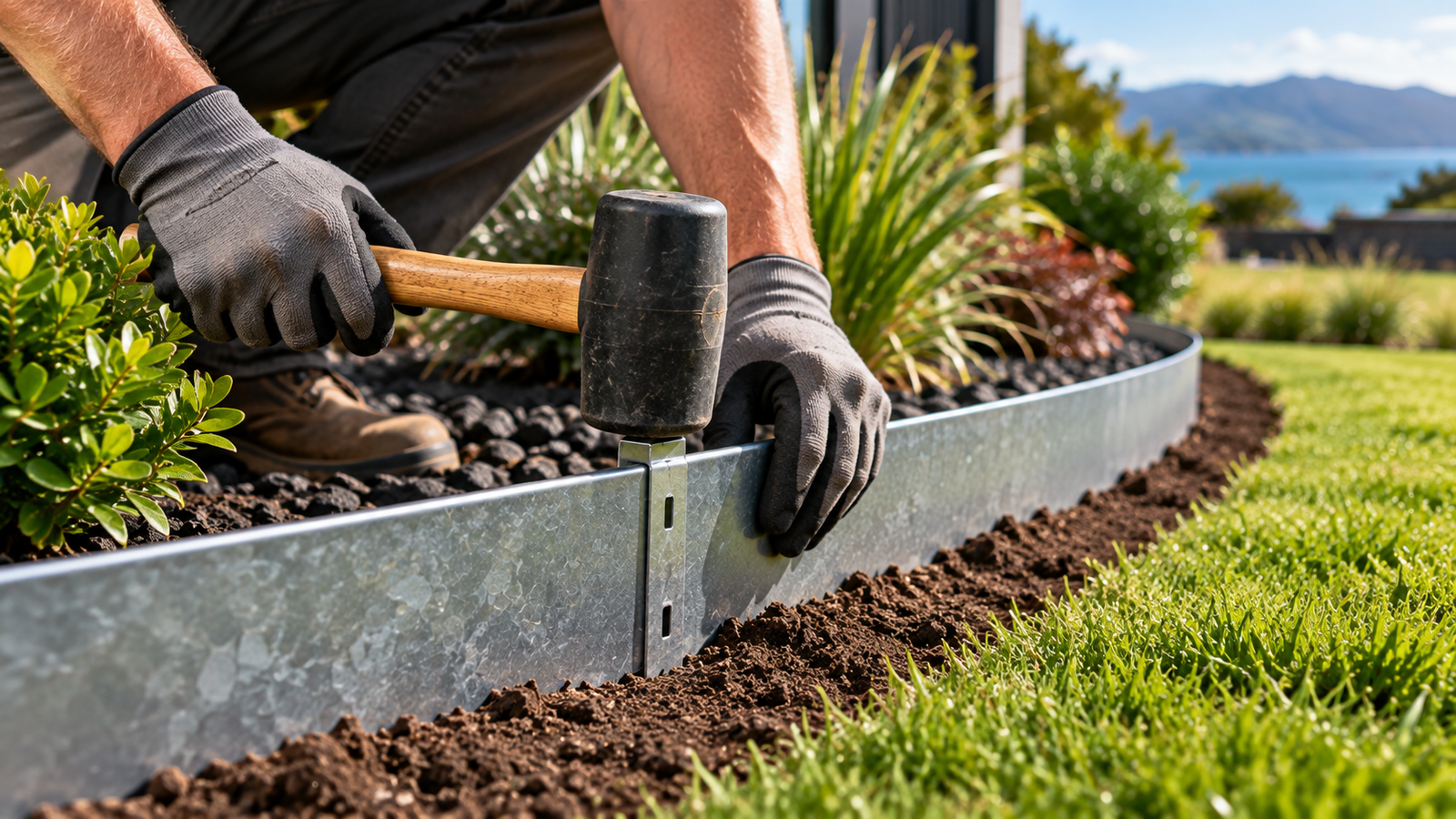
Installation varies by brand, but the basic workflow is consistent: mark the layout, measure carefully, prepare the ground, connect the sections, secure them and backfill.
-
Set out the line.
Use string for straight sections or a hose/twine for curves. Stand back and check the shape before digging. -
Measure the full run.
Bunnings NZ recommends adding about 10% to the measured length as a contingency. For curves, measure along the actual curved route rather than across it. -
Prepare a narrow trench where required.
Bunnings recommends a trench suitable for the chosen edging, while DLM Wallace suggests an optional trench of roughly 50 mm for its Corten system to improve security and finish. -
Connect sections before final fixing.
Follow the manufacturer’s clip, interlock or joiner system. Keep joins away from tight bends when the instructions require it. -
Set the finished height.
Use a string line on long straight runs and check that the top edge is consistent before hammering everything fully into place. -
Secure the edging.
Some steel systems use integrated spikes; others use separate pegs or clips. Use a rubber mallet where appropriate and protect finished surfaces from direct hammer blows. -
Backfill and compact lightly.
Replace soil around both sides so the edge is supported, then recheck alignment before finishing mulch, lawn or gravel.
Where steel edging works best
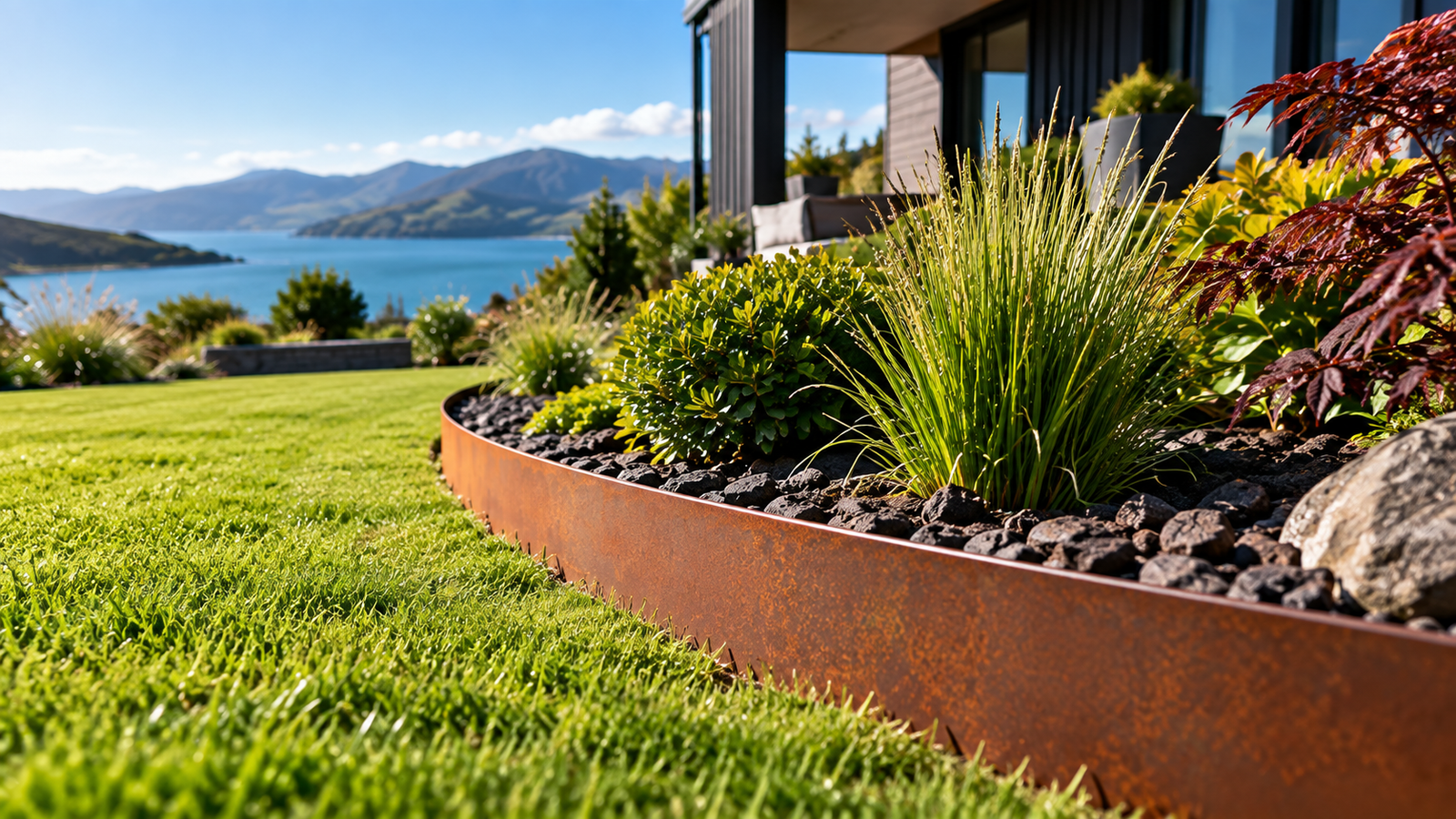
Between lawn and garden beds
This is one of the strongest use cases. A narrow steel line gives the mower-side border a clean appearance without the visual bulk of sleepers or masonry.
Around gravel paths
Steel can separate gravel from lawn, soil or planting beds. Choose enough visible height to contain the aggregate without leaving an unnecessarily high exposed edge.
Curved feature beds
Flexible edging can create long sweeps and organic curves that are difficult to achieve cleanly with rigid timber.
Modern and architectural gardens
Dark powder-coated steel can almost disappear, while Corten can do the opposite and deliberately highlight the geometry of the garden.
Steel vs timber garden edging
Neither material is automatically better. The right choice depends on the look you want, how tight the curves are, the amount of soil being contained and how much future maintenance you are comfortable with.
| Factor | Steel | Timber |
|---|---|---|
| Visual profile | Thin and crisp | Broader and more natural |
| Curves | Excellent with flexible profiles | Better for straight or gently segmented layouts |
| Cutting / DIY | May require metal-cutting tools depending on system | Usually straightforward with common woodworking tools |
| Ground-contact decay | No timber rot, but finish and corrosion behaviour depend on steel type | Treatment and timber durability are important |
| Look | Modern, minimal or architectural | Warm, traditional and natural |
If you prefer the warmer look of wood, see our detailed guide to timber garden edging in NZ, including H4 treatment, timber choices and installation.
Common steel edging mistakes
- Buying by piece price only: compare length, height, thickness, connectors and freight.
- Choosing rigid edging for tight curves: confirm whether the profile is actually designed to bend.
- Leaving the top edge uneven: small height variations become obvious on long lawn borders.
- Using too little support: follow the correct spike or peg spacing for the system.
- Ignoring runoff from weathering steel: rust-coloured water can mark adjacent porous surfaces.
- Expecting thin edging to retain significant soil: use a structural retaining solution where required.
Maintenance and lifespan
Steel edging is generally low-maintenance once properly installed. The main jobs are keeping grass and soil from building over the top edge, checking that sections remain aligned after soil movement, and inspecting joins if the border is exposed to repeated mower or wheel contact.
Galvanised and powder-coated products rely on their protective finish, so avoid unnecessary damage during cutting and installation. Weathering steel is different: its changing surface appearance is intentional, and the early patina stage can produce runoff before the surface stabilises.
Root & Yard verdict
Steel garden edging is one of the best choices for Kiwi gardens when the priority is a clean, narrow and durable-looking border. Galvanised or coated steel makes the most sense when you want the edge to stay visually quiet, while Corten-style weathering steel is worth considering when the border itself is part of the design.
For most homeowners, the smartest purchase is not automatically the thickest or most expensive product. Match the profile to the shape of the garden, compare cost per metre, check what fixings are included and choose a system whose installation method suits your soil and DIY skills.
Steel garden edging NZ: frequently asked questions
Is steel garden edging worth it?
It can be. Steel is particularly useful when you want a thin, crisp boundary around lawns, beds or gravel without the bulk of timber or masonry. Its value is strongest in long visible runs and curved designs where a clean line matters.
Does steel garden edging rust?
It depends on the product. Galvanised and powder-coated steel use protective finishes to resist corrosion. Weathering steel such as Corten is specifically designed to develop a rust-coloured patina as part of its normal appearance.
Is Corten steel good for garden edging?
Yes, especially when you want a warm, architectural rusted finish. Keep in mind that runoff during weathering can stain nearby porous surfaces, so placement matters.
How deep should steel edging be installed?
There is no universal depth. Some systems sit partly in a trench, while others use integrated spikes or dedicated pegs. Follow the instructions for the exact profile you buy and set the exposed height according to the lawn, mulch or gravel it is separating.
Can steel edging be curved?
Many steel edging systems are designed to curve, but not all of them. Flexible and rigid versions can even exist within the same product range, so check the specification before trying to form a tight bend.
Is steel edging better than timber?
Steel is usually better for very thin lines, smooth curves and a modern look. Timber is often easier to cut with common DIY tools and suits gardens where a warmer, more natural border is preferred. The best choice depends on the project.
0 Comentários