If you want to learn how to grow tomatoes NZ gardeners can rely on, getting the planting time, sunlight, soil, watering and feeding right makes all the difference. Few things say Kiwi summer quite like picking a ripe tomato straight from the garden.
Tomatoes are one of New Zealand’s favourite summer crops, and they can be grown successfully in traditional vegetable gardens, raised beds, containers and even relatively small outdoor spaces.
But timing matters.
Plant too early and cold conditions or a late frost can set young plants back. Plant too late and you shorten the warm growing season available for flowering, fruit development and ripening.
The trick is to stop thinking of New Zealand as having one universal tomato planting date. From warmer northern gardens to cooler parts of the South Island, the best planting window changes with local conditions.
This guide explains how to grow tomatoes NZ gardeners can enjoy throughout summer, including when to plant, choosing varieties, preparing the soil, growing tomatoes in pots and raised beds, watering, feeding, staking, pruning and dealing with common problems.
How to Grow Tomatoes NZ: When Should You Plant Them?
For many Kiwi gardeners, Labour Weekend is synonymous with planting tomatoes.
There is a practical reason behind the tradition. By late October, conditions across much of New Zealand are becoming warmer and the risk of frost has generally reduced.
However, Labour Weekend should be treated as a useful guideline rather than a fixed planting deadline.
Your local climate matters more than the date on the calendar.
Warmer northern gardens may be ready for outdoor tomatoes earlier in spring. Cooler inland or southern gardens may still experience cold nights or frost well after gardeners elsewhere have begun planting.
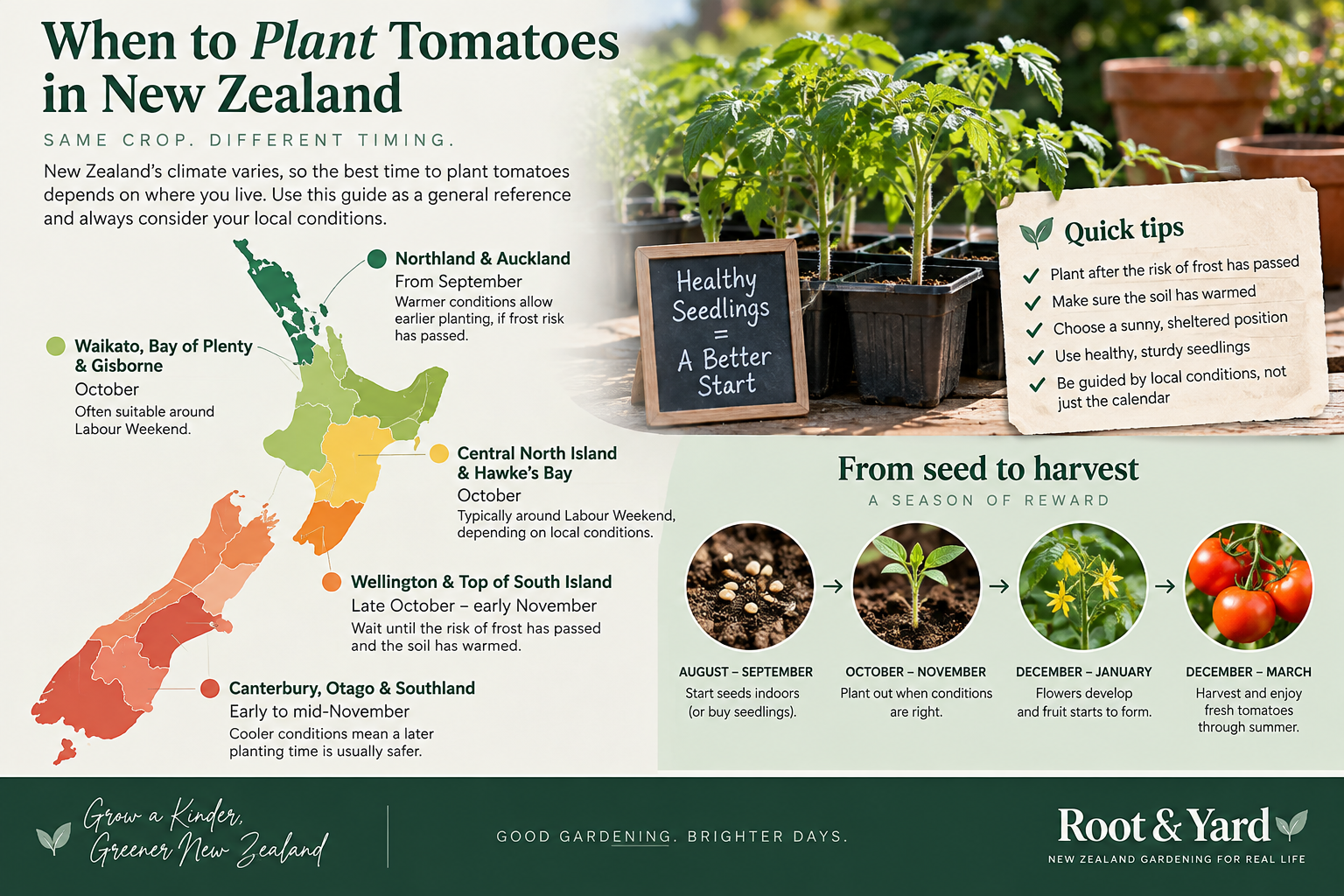
Tomato Planting Times Around New Zealand
| Location or conditions | General outdoor planting window |
|---|---|
| Warm northern areas | From September where conditions are warm and frost-free |
| Much of New Zealand | October, commonly around Labour Weekend |
| Cooler or frost-prone areas | Late October into November |
| Very cold microclimates | Wait until frost risk has passed and conditions have warmed |
These dates are guides rather than guarantees.
A sheltered urban garden can behave differently from an exposed rural property nearby. Elevation, wind, frost pockets, coastal influence and the orientation of your garden can all change the effective growing season.
Can You Start Tomatoes Earlier?
Yes. Starting tomatoes from seed under protection lets you get ahead of the outdoor planting season.
Seeds can be raised indoors, in a greenhouse or in another warm, bright and protected environment before seedlings are transplanted outside.
Growing Tomatoes From Seed vs Seedlings
Both approaches can work well.
Growing tomatoes from seed
Seeds provide access to a much wider range of tomatoes, including unusual and heirloom varieties that may not be available as seedlings.
Start seeds in quality seed-raising mix in a warm, bright position. Once seedlings develop true leaves and become large enough to handle, move them into individual pots if required.
Before permanently moving them outside, harden them off.
This means gradually exposing seedlings to outdoor conditions over several days rather than taking plants from a sheltered environment and immediately leaving them outside day and night.
Buying tomato seedlings
Seedlings are the easiest option if you want to skip propagation.
Look for plants that are:
- compact and sturdy
- healthy green
- free from obvious pests
- not severely root-bound
- not excessively tall and weak
Don’t automatically choose the biggest plant at the garden centre. A compact, healthy seedling can establish better than a stretched plant that has spent too long in a small pot.
Choosing the Right Tomato Variety
Before planting, think about what you actually want from your crop.
Do you want handfuls of sweet cherry tomatoes throughout summer? Large tomatoes for sandwiches? Fleshy fruit for sauces? Or a compact plant suitable for a patio container?
Tomatoes broadly fall into two growth habits.
Determinate tomatoes
Determinate tomatoes grow to a more defined size and tend to produce much of their crop over a relatively concentrated period.
They are often called bush tomatoes.
Their compact growth can make them useful for:
- containers
- smaller gardens
- gardeners who don’t want enormous vines
- harvesting larger quantities over a shorter period
Indeterminate tomatoes
Indeterminate tomatoes continue producing vine growth through the season while conditions remain favourable.
They generally need stronger support and more ongoing management. In return, they can continue flowering and producing fruit over an extended period.
Popular tomato types for Kiwi gardens
| Type | Useful for |
|---|---|
| Sweet 100 | Prolific cherry tomatoes and regular summer picking |
| Money Maker | Traditional general-purpose tomatoes |
| Beefsteak types | Large slicing tomatoes |
| Roma types | Cooking, sauces and fleshy fruit |
| Compact/dwarf varieties | Containers and small spaces |
| Heirloom varieties | Unusual colours, shapes and flavours |
There isn’t one universally “best tomato for NZ”.
The better question is: which tomato suits your climate, available space and how you intend to use the fruit?
Where Should You Grow Tomatoes?
One of the most important parts of learning how to grow tomatoes NZ gardeners can harvest successfully is choosing the right position.
Tomatoes want warmth and sunshine.
Choose a position receiving at least six hours of direct sunlight, with more generally beneficial where conditions allow.
Also consider wind.
Tomatoes benefit from airflow, but an exposed site hit by strong prevailing winds can damage plants, dry containers rapidly and make staking more difficult.
Preparing Soil for Tomatoes
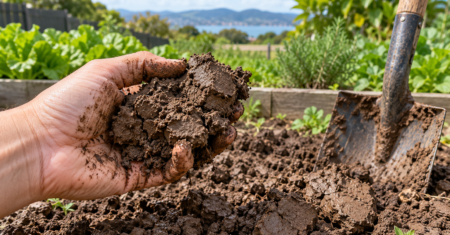
Tomatoes are hungry plants. They perform best in fertile soil containing plenty of organic matter while still draining effectively.
Before planting, incorporate mature compost into the bed.
If you’re dealing with difficult ground, don’t ignore the underlying problem. Tomatoes can struggle in persistently waterlogged soil.
If your garden has heavy clay, read our Clay Soil NZ guide before planting. Improving a broader area is generally better than digging a small hole and filling it with premium soil while leaving dense clay around it.
Rotate tomato crops where possible
Tomatoes belong to the same plant family as potatoes, capsicums and eggplants.
Where your garden has enough space, avoid repeatedly growing tomatoes and closely related crops in exactly the same soil year after year.
Perfect crop rotation isn’t always practical in small gardens, so soil health, garden hygiene and careful monitoring become even more important where rotation options are limited.
How to Plant Tomato Seedlings
Once frost risk has passed and conditions are warm enough, planting is straightforward.
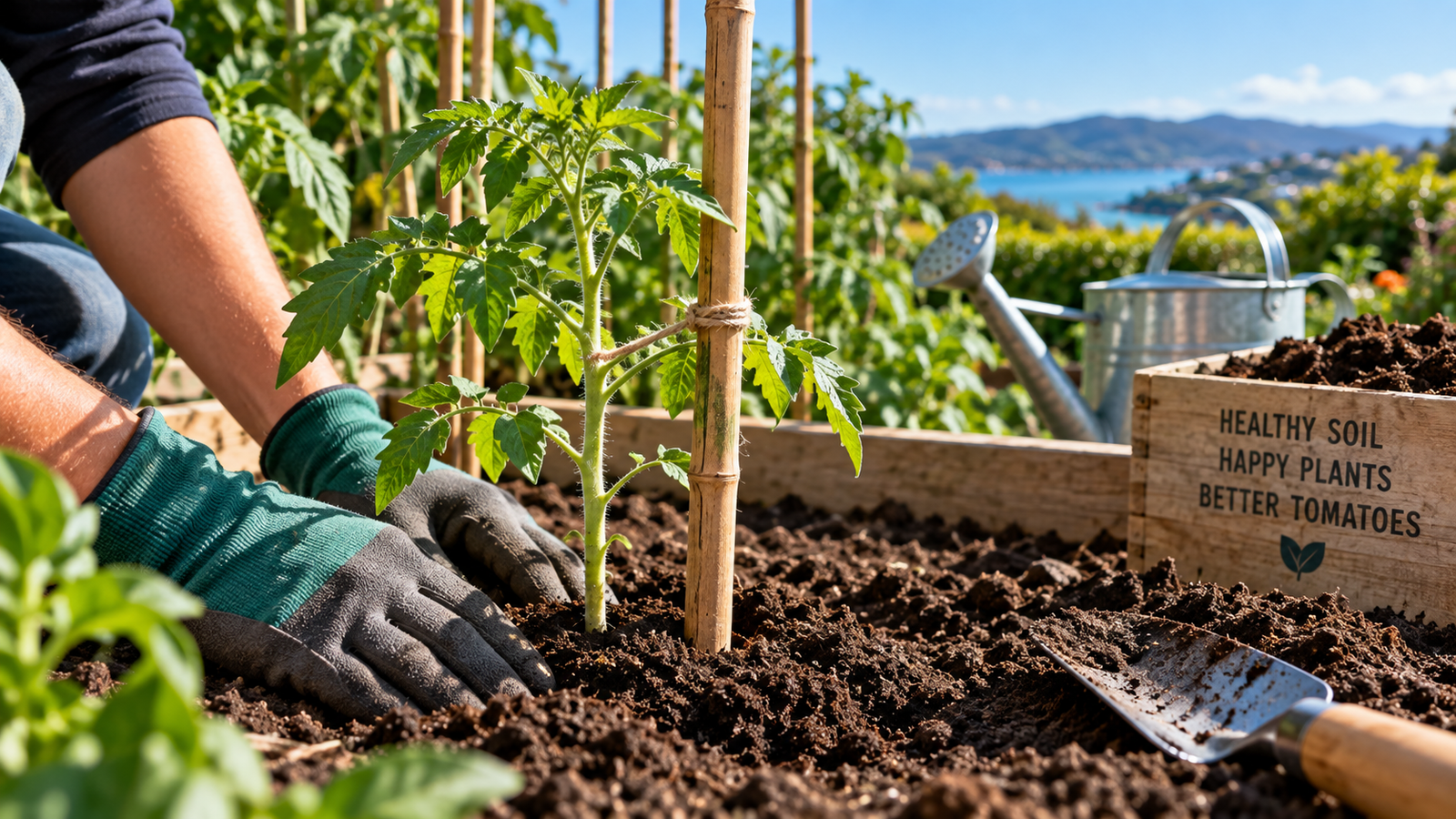
- Prepare the bed. Remove weeds and incorporate mature compost into the soil.
- Install the support. If the variety requires staking, place the support before or at planting time.
- Allow enough space. Follow the spacing recommendation for your variety and avoid crowding plants.
- Plant the seedling. Position it carefully and gently firm the surrounding soil.
- Water thoroughly. Give the plant a good initial watering to settle soil around the roots.
- Mulch the bed. Once established, mulch can reduce moisture fluctuations and suppress weeds.
How to Grow Tomatoes in Pots in NZ
No vegetable garden? No problem.
Tomatoes can grow very successfully in containers.
The common mistake is trying to grow a vigorous tomato plant in a tiny decorative pot.
A larger container provides:
- more root space
- a larger nutrient reserve
- more stable soil moisture
- less dramatic drying during hot weather
Use a container with adequate drainage holes, quality growing mix and enough volume for the mature plant.
As a practical minimum, choose a deep container around 30 cm or more, but larger containers can make vigorous tomato varieties considerably easier to manage.
Container tomato checklist
- Good drainage holes
- Quality potting or vegetable mix
- Enough room for the mature root system
- Strong sunlight
- Support for tall varieties
- Regular watering
- Ongoing feeding
Container tomatoes require closer attention to watering and feeding because their roots cannot explore the surrounding garden soil.
Growing Tomatoes in Raised Beds
Raised beds are an excellent option where native soil is compacted, heavy or difficult to manage.
They make it easier to control the growing medium and can create a productive vegetable garden above poor existing ground.
However, a raised bed doesn’t automatically eliminate drainage problems underneath it.
If your garden sits on very heavy clay and regularly becomes waterlogged, consider where water from the raised bed will eventually go.
Our Raised Garden Beds NZ guide covers raised-bed planning and growing conditions in more detail.
How to Support Tomato Plants
Most tall-growing tomatoes need support.
Options include:
- sturdy stakes
- tomato cages
- trellis systems
- other purpose-built supports
Install the support early and attach stems as the plant grows using soft ties that won’t cut into them.
Compact dwarf varieties may need considerably less support.
How Often Should You Water Tomatoes?
There isn’t a perfect watering schedule that applies to every New Zealand garden.
A tomato growing in a container during a hot northern summer will behave very differently from one planted in open ground during a cool, cloudy week.
Instead of blindly watering on a schedule, aim for consistent soil moisture.
Water deeply enough to reach the root zone rather than repeatedly sprinkling only the surface.
Where practical, water the soil rather than the foliage.
Why consistent watering matters
Large fluctuations between very dry and very wet conditions can contribute to:
- fruit splitting
- blossom end rot
- plant stress
- reduced fruit quality
Mulch becomes particularly useful as summer temperatures increase.
Feeding Tomato Plants
Tomatoes produce substantial growth and fruit over a relatively short period, so they require adequate nutrients.
Start with fertile soil enriched with organic matter and use an appropriate tomato or vegetable fertiliser during the growing season according to its directions.
Should You Remove Tomato Laterals?
You’ll often hear Kiwi gardeners talking about laterals.
These are side shoots that develop where a leaf meets the main stem.
For vigorous indeterminate tomatoes, removing selected laterals can help keep plants manageable and improve airflow.
But don’t blindly remove every side shoot from every tomato.
Bush or determinate tomatoes grow differently and generally don’t require the same pruning approach.
Know what type of tomato you’re growing before reaching for the secateurs.
Should you remove lower leaves?
As plants mature, removing old or unhealthy lower foliage can improve airflow and keep leaves away from damp soil.
Avoid stripping a healthy plant excessively. Leaves are still responsible for photosynthesis.
The objective is a healthy, reasonably open plant — not a bare stem.
Mulching Tomatoes
Mulch can:
- reduce water loss
- suppress weeds
- moderate soil-temperature fluctuations
- help maintain consistent moisture
- reduce soil splashing onto lower foliage
Pea straw, suitable composted materials and other garden mulches can work well.
Keep mulch slightly away from the main stem.
Common Tomato Problems in New Zealand
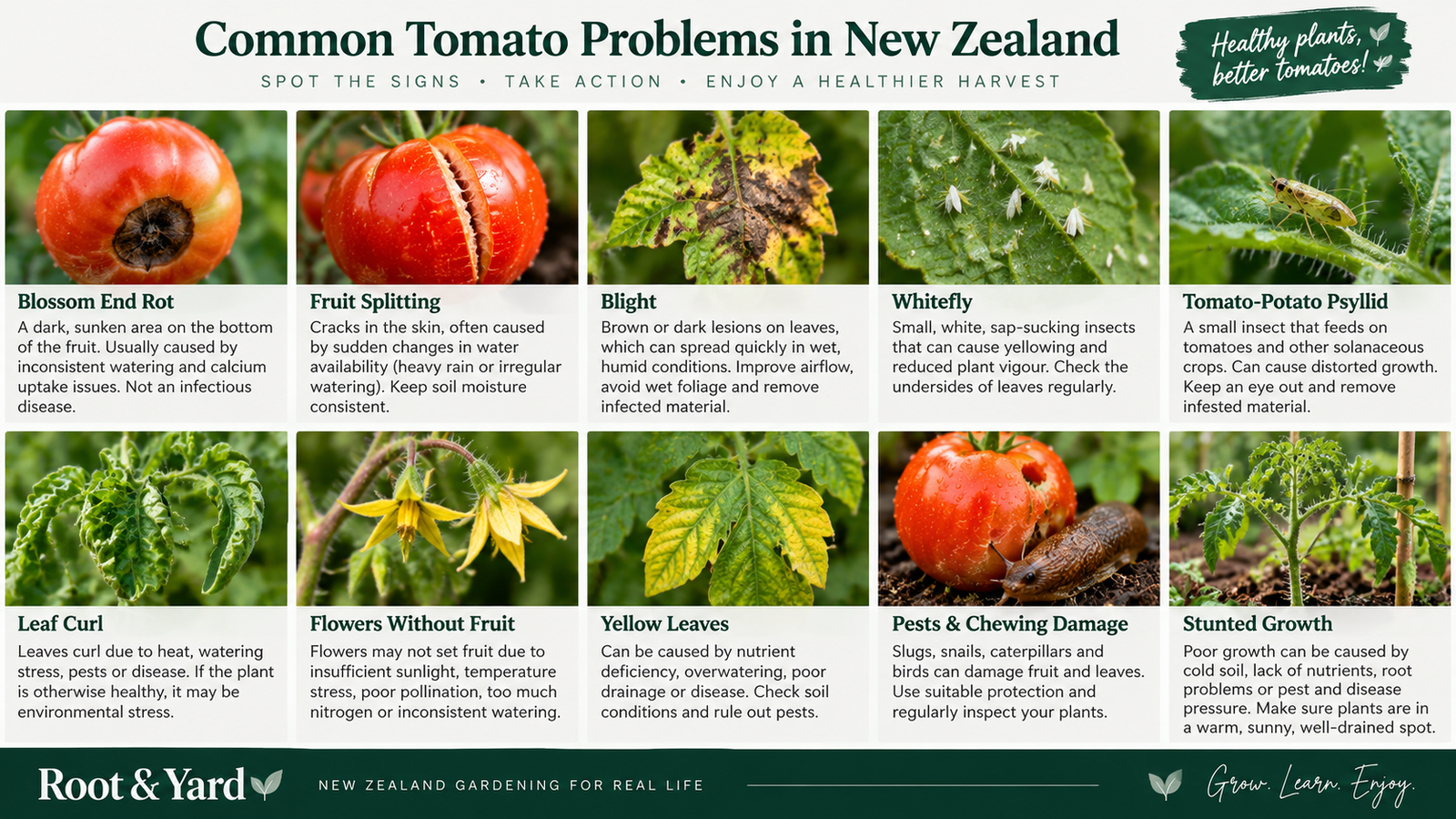
Warm weather, humidity, inconsistent watering, pests and disease can all create problems during tomato season.
Blossom end rot
A dark, sunken area develops at the blossom end of the fruit.
Despite its name, blossom end rot is not an infectious disease spreading from tomato to tomato. It is a physiological disorder associated with calcium availability within developing fruit, and inconsistent moisture can be an important contributing factor.
Container tomatoes can be particularly vulnerable because pots can dry rapidly during warm weather.
Fruit splitting
Tomatoes can split when fruit expands faster than the skin can accommodate.
Sudden changes in water availability can contribute to the problem, particularly when dry conditions are followed by substantial rain or watering.
Consistent moisture can reduce the risk.
Tomato blight
Blight can become a serious problem during favourable wet and humid conditions.
Depending on the disease involved, symptoms can include dark lesions, browning foliage, wilting and rapid plant decline.
Good prevention practices include:
- adequate spacing
- good airflow
- watering around the root zone rather than foliage
- crop rotation where practical
- removing diseased material
- cleaning garden tools
Whitefly
Check the undersides of tomato leaves regularly.
Whiteflies are small sap-sucking insects that can reduce plant vigour and contribute to yellowing foliage.
Regular inspection makes populations easier to identify before they become severe.
Tomato-potato psyllid
This pest deserves particular attention in a New Zealand tomato guide.
Tomato-potato psyllid attacks tomatoes and other related crops, including potatoes, capsicums and eggplants.
Regularly inspect plants and maintain good crop hygiene. Remove heavily affected plant material and control host weeds around the vegetable garden.
For more information about identifying and managing tomato-potato psyllid in New Zealand, see BioForce’s tomato-potato psyllid guide.
Why Is My Tomato Flowering but Not Producing Fruit?
Flowers without developing tomatoes can have several causes.
Possible factors include:
- insufficient sunlight
- temperature stress
- poor pollination
- excessive nitrogen
- inconsistent watering
- general plant stress
Don’t immediately add more fertiliser.
Look at the complete growing environment first.
Why Are My Tomato Leaves Curling?
Leaf curl is a symptom rather than a diagnosis.
Heat, temperature changes, water stress, pests and disease can all affect tomato foliage.
If the plant otherwise looks healthy and continues growing and producing fruit, environmental stress may be responsible.
However, curling combined with severe yellowing, stunted growth, unusual deposits or obvious pest activity deserves closer investigation.
When Are Tomatoes Ready to Harvest in New Zealand?
Harvest timing depends heavily on planting date, variety, region, sunlight, temperature and seasonal weather.
Many tomatoes take roughly 10–14 weeks from planting to maturity, although individual varieties vary considerably.
For many spring-planted crops, harvesting begins during summer and can continue into early autumn while conditions remain suitable.
For standard red varieties, look for developed colour and fruit that has begun to soften rather than remaining hard and pale.
Heirloom and differently coloured tomatoes require different visual cues, so know the mature colour expected from your variety.
What Should You Do at the End of Tomato Season?
Don’t simply abandon exhausted vines in the garden.
Remove finished plants and clean up fallen plant material.
If plants suffered significant disease, avoid putting heavily infected material into a typical home compost system where pathogens may survive.
Clean stakes, cages and tools before storing them.
Make a note of where tomatoes and potatoes were grown so you can rotate crops next season if space allows.
Simple Tomato-Growing Calendar for NZ
10 Tomato-Growing Mistakes to Avoid
- Planting outside too early. Tomato seedlings being available for sale doesn’t mean frost risk has disappeared in your garden.
- Choosing a shady position. Tomatoes require substantial sunlight.
- Using tiny containers. Small pots restrict roots and dry rapidly.
- Installing stakes too late. You risk damaging established roots.
- Crowding plants. Poor airflow can increase disease pressure.
- Alternating drought with heavy watering. Consistency matters.
- Regularly soaking foliage. Direct irrigation towards the root zone where practical.
- Overfeeding with nitrogen. Lots of leaves doesn’t necessarily mean lots of tomatoes.
- Pruning every variety identically. Bush and vining tomatoes have different growth habits.
- Ignoring diseased plants after harvest. End-of-season garden hygiene matters.
Frequently Asked Questions
What month do you plant tomatoes in New Zealand?
September to November is the broad spring planting period. Warmer northern gardens may start earlier, much of New Zealand traditionally plants around Labour Weekend in late October, and colder locations may need to wait until November.
Is Labour Weekend the best time to plant tomatoes?
It is a useful traditional guide for much of New Zealand rather than a strict rule. If frost remains possible or the soil is still cold, wait. Warmer areas may be ready earlier.
Do tomatoes grow well in pots?
Yes. Tomatoes can be highly productive in containers when the pot is large enough, drains properly and receives plenty of sunlight. Compact varieties are particularly convenient for smaller spaces.
How much sun do tomatoes need in NZ?
Aim for at least six hours of direct sunlight each day. A warm, sunny position with some shelter from strong winds is generally ideal.
How often should I water tomatoes?
Water according to soil conditions, weather and container size rather than following a rigid schedule. Aim for deep and reasonably consistent moisture without keeping the soil permanently saturated.
Should I remove laterals from tomato plants?
Removing selected laterals can help manage vigorous indeterminate tomatoes and improve airflow. Determinate or bush tomatoes generally should not be pruned in exactly the same way.
Can tomatoes grow in clay soil?
Yes, but tomatoes prefer fertile, well-drained soil. Heavy clay should be improved with organic matter and appropriate drainage, or tomatoes can be grown in raised beds or containers.
Why are the bottoms of my tomatoes going black?
A dark sunken patch at the blossom end is commonly blossom end rot. It is a physiological disorder rather than a contagious disease, and inconsistent moisture can contribute to the problem.
When can I harvest tomatoes in New Zealand?
Many spring-planted tomatoes begin producing during summer. A rough guide is around 10–14 weeks from planting to maturity, although variety, planting date and weather can shift this considerably.
For additional seasonal growing advice, see Tui Garden’s tomato growing guide.
Final Verdict: How to Grow Tomatoes NZ Successfully
Learning how to grow tomatoes NZ gardeners can harvest throughout summer is less about finding one secret fertiliser or following one rigid planting date and more about getting the fundamentals right.
Wait for warmth. Give them sun. Build healthy, well-drained soil. Support plants early. Water consistently. Feed sensibly. Keep an eye on pests and disease.
For much of the country, Labour Weekend remains a useful signal that tomato season is getting underway. But your own garden should have the final say.
A gardener in a warm northern location and one in a frost-prone southern garden shouldn’t plant simply because the calendar shows the same date.
Work with your local conditions, choose a variety suited to your space and keep moisture reasonably consistent. Get those basics right and a few healthy tomato plants can keep a Kiwi household harvesting throughout summer.
0 Comments