Lawn care · New Zealand gardening
Noticed clover spreading across your lawn, tiny prickles underfoot, or unfamiliar leaves pushing through the grass? This New Zealand guide helps you identify common lawn weeds, choose the right removal method and make your lawn less welcoming to future invaders.
To get rid of lawn weeds in NZ, first identify the weed and your lawn grass. Pull isolated weeds with their roots, repair thin turf and use a lawn-labelled selective herbicide only where appropriate. Treat actively growing weeds in suitable weather, follow the product label and keep children and pets away until the label says it is safe. Onehunga prickle weed is best tackled before its prickly seeds form.
Common lawn weeds in New Zealand: what are you looking at?
The first step is identification. A broadleaf weed such as dandelion behaves differently from a creeping plant such as hydrocotyle, and both differ from unwanted grasses such as kikuyu or annual poa. A treatment suitable for one may be ineffective or damaging to another.
Clover
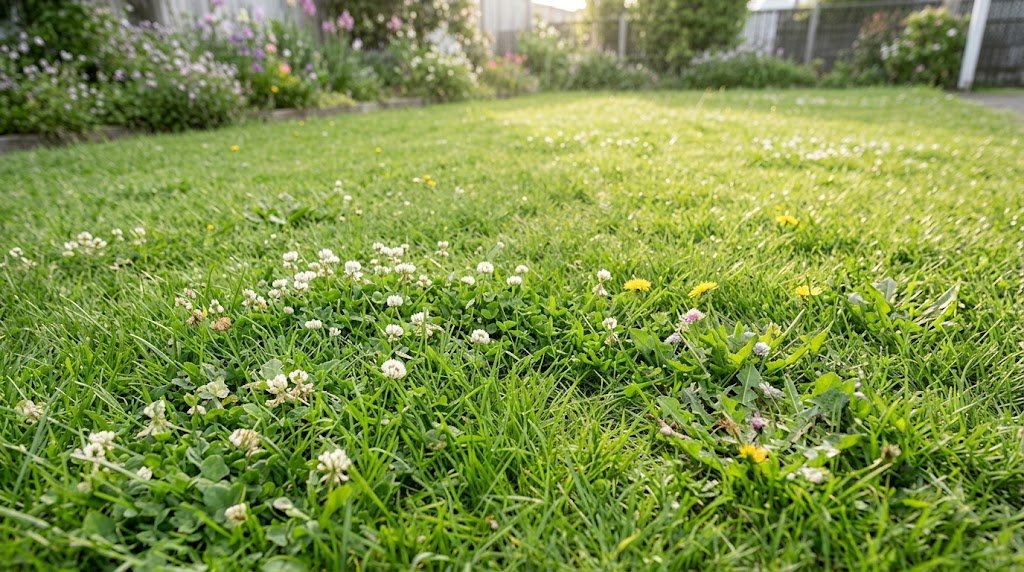
Clover forms low patches of three-part leaves and may produce white, pink or purple flowers. It can thrive where turf is thin or underfed. Clover also fixes nitrogen, so some homeowners deliberately keep it for a mixed lawn; removal is a preference, not a necessity.
Onehunga prickle weed (bindii)
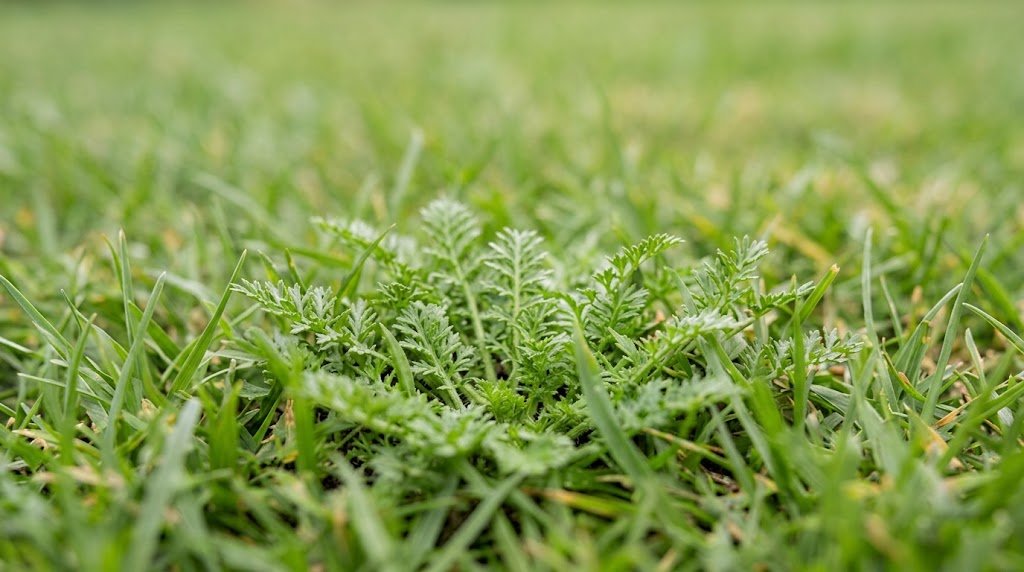
This low-growing weed is especially frustrating for barefoot summer use. It produces sharp, prickly seeds that can catch on feet and paws. Look for small, finely divided leaves close to the ground. Prevention is about controlling plants before the prickles develop, rather than waiting until they are already scattered through the lawn.
Oxalis
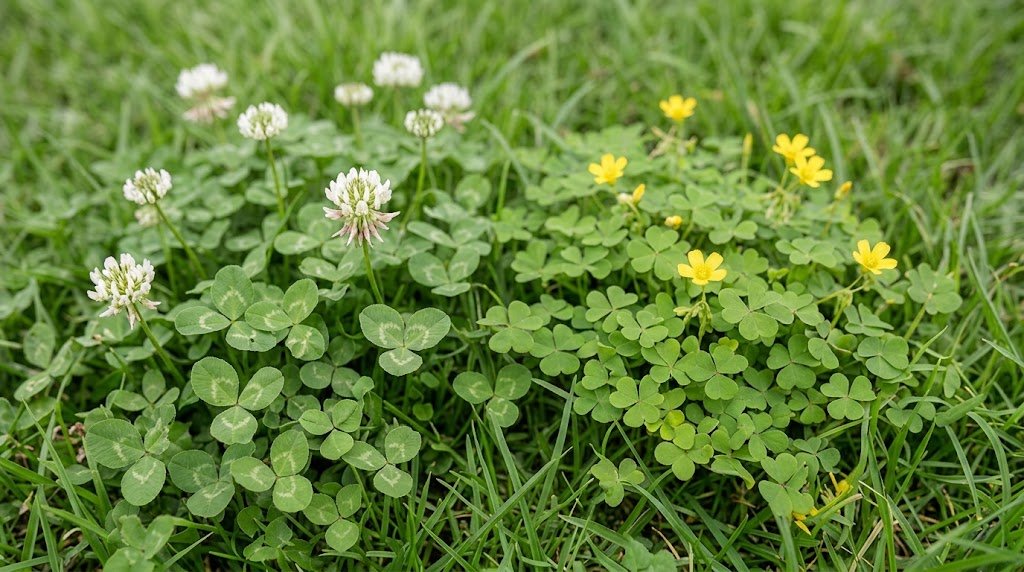
Oxalis often resembles clover, but its leaflets are typically heart-shaped. Some species have yellow flowers and spread through bulbs or bulbils, making repeated hand-pulling less effective if underground parts remain.
Hydrocotyle
Hydrocotyle is a creeping, mat-forming weed with small rounded leaves. It often appears in damp, shaded or poorly drained areas, so improving the site conditions matters as much as removing the visible growth.
Dandelion, plantain and daisies
Dandelions have toothed leaves in a basal rosette, yellow flowers and a substantial taproot. Plantain forms a rosette of broad or narrow leaves with prominent veins. Lawn daisies stay low and produce small white flowers with yellow centres. All can establish in gaps where grass coverage is weak.
Unwanted grasses: kikuyu and poa
Kikuyu spreads vigorously by runners, while annual poa can form pale green tufts and seedheads. Because these are grasses, ordinary broadleaf lawn weed killers may not solve the problem. Identify your desirable turf before choosing any grass-weed treatment.
Lawn weeds NZ: quick identification and control table
| Weed | How to recognise it | First action | Important caution |
|---|---|---|---|
| Clover | Three leaflets, creeping patches, small flower heads | Improve turf density; hand-remove small patches or use a compatible selective product | Some people intentionally grow clover lawns |
| Onehunga prickle weed | Low, fine foliage; painful prickly seeds later in the season | Identify and treat before seed formation | Late treatment cannot remove prickles already formed |
| Oxalis | Heart-shaped leaflets; often yellow flowers | Remove carefully, including underground structures where practical | Bulbils and seeds can cause regrowth |
| Hydrocotyle | Rounded leaves, creeping mats, often damp spots | Improve drainage and turf health; consider a labelled selective treatment | Persistent wet conditions favour return |
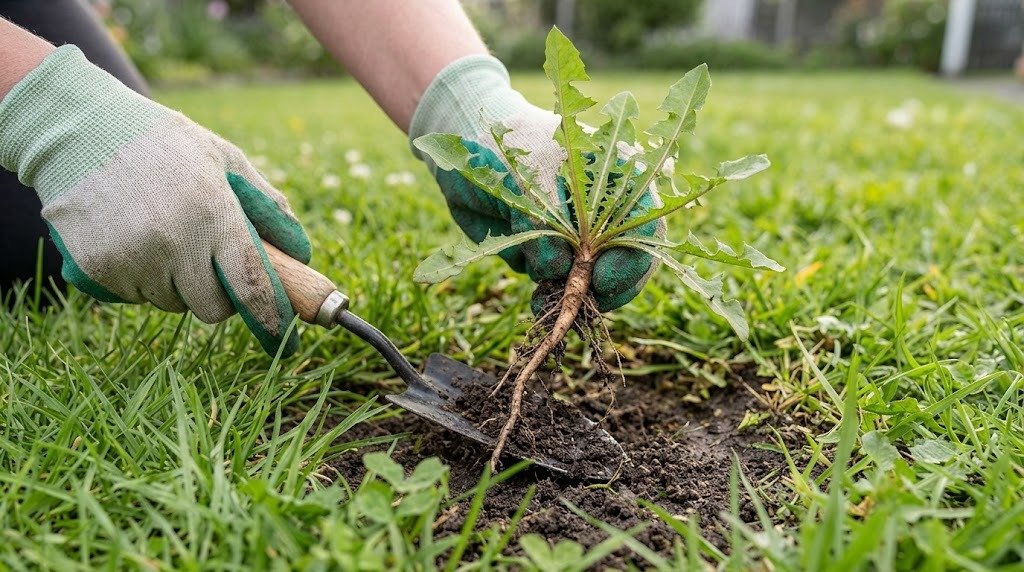
| Dandelion | Jagged leaf rosette, yellow flower, taproot | Lift the root with a weeding tool | Root fragments may regrow |
| Plantain | Flat rosette, strong leaf veins, upright seed stalks | Remove individual plants and relieve compaction | Thin, compacted lawns invite reinfestation |
| Kikuyu / annual poa | Grass-like growth unlike surrounding turf | Identify both weed grass and desirable lawn type | Broadleaf herbicides are not a universal solution |
How to get rid of weeds in a lawn without killing the grass
- Identify the weed and turf. Check the leaves, flowers, roots and growth habit. If unsure, photograph a close-up and ask a local garden centre.
- Remove small outbreaks by hand. Work when the soil is slightly moist. Use a narrow weeding tool to lift taproots and gather runners or bulbs without scattering them.
- Choose spot treatment before blanket spraying. For larger broadleaf outbreaks, select a product specifically labelled for lawns, your grass species and the target weed. Read the entire current NZ label.
- Pick suitable weather. Many selective products work best on actively growing weeds during spring or autumn. Avoid wind, extreme temperatures and imminent rain unless the label explicitly permits those conditions.
- Protect nearby plants and people. Prevent spray drift onto vegetables, ornamentals and waterways. Wear the protective equipment on the label and follow its restrictions for children and pets.
- Repair the gaps. Once the treatment’s reseeding interval has passed, loosen compacted soil if needed and overseed with an appropriate lawn seed mix. Water new seed as directed.
How to tackle stubborn lawn weeds
How to get rid of clover in a lawn NZ
For a few patches, lift the runners and rooted nodes by hand. Where clover is widespread, improve lawn nutrition and grass density before deciding whether a lawn-compatible selective herbicide is necessary. If you want a pollinator-friendly mixed lawn, clover may be worth keeping.
How to get rid of oxalis in a lawn NZ
Distinguish oxalis from clover by the leaf shape and flowers. Remove isolated plants carefully, avoiding unnecessary soil disturbance that spreads bulbils. Recheck the area for new growth. Yates NZ identifies selective hydrocotyle products as an option for certain oxalis species in grass lawns; always confirm your product’s current label and turf compatibility.
How to deal with Onehunga prickle weed
Act early. In many New Zealand lawns, the useful treatment window is before the weed flowers and forms its prickly seeds. A suitable lawn-labelled selective treatment may control living plants, but it will not make existing sharp seeds disappear. Regular monitoring in late winter and spring helps avoid an unpleasant summer surprise.
How to remove hydrocotyle
Hydrocotyle can keep returning where soil stays damp and grass struggles. Alongside removing the weed, investigate drainage, shade and compaction. Where appropriate, use a selective treatment specifically listing hydrocotyle. Avoid applying lime automatically: test soil pH first and amend only when the result supports it.
What about moss?
Moss is not a broadleaf weed, and a typical broadleaf weed killer is not a complete moss solution. For shade, drainage and moss-removal steps, see our guide to getting rid of moss in NZ lawns.
When is the best time to kill lawn weeds in NZ?
| Season | What to prioritise |
|---|---|
| Spring (September–November) | Identify actively growing broadleaf weeds, monitor Onehunga before prickles develop and thicken thin turf. Check temperatures and label conditions before spraying. |
| Summer (December–February) | Remove isolated weeds, water deeply when appropriate and avoid stressing dry lawns with unsuitable treatments. Existing Onehunga prickles may remain even after plants die. |
| Autumn (March–May) | Target actively growing weeds, repair bare patches and establish stronger grass while soil conditions remain suitable. |
| Winter (June–August) | Identify drainage problems, limit damage to waterlogged soil and plan early control of weeds before spring seed production. |
New Zealand climates vary significantly between Northland, Auckland, Wellington, Canterbury and Otago. Use the condition of your lawn and the product label—not the calendar alone—to decide when to act.
Seven ways to stop lawn weeds coming back
- Mow at the right height. Avoid repeatedly scalping the lawn, which opens gaps for weed seedlings.
- Feed according to your grass type. A vigorous, appropriately fertilised lawn competes better with weeds.
- Water wisely. Encourage deeper rooting while avoiding persistent waterlogging.
- Fix compacted soil. Aerate when conditions suit the lawn and improve drainage where necessary.
- Overseed bare areas. Match the seed to the local climate, sunlight and existing turf.
- Remove weeds before they set seed. This is particularly important for Onehunga prickle weed.
- Check regularly. Small outbreaks are usually easier to manage than established mats or runners.
Weed control is only half the job. Dense, healthy grass is the best foundation for keeping new weeds from taking over. If the same weed returns every year, look for the underlying cause: shade, poor drainage, compaction, bare soil or unsuitable grass for the site.
Common mistakes that make lawn weeds worse
- Using a non-selective herbicide across the lawn. It may kill the grass alongside the weeds.
- Treating weeds after seed production. The plants may die while viable seeds or prickles remain.
- Spraying an unidentified grass weed. Broadleaf products generally do not target all invasive grasses.
- Ignoring reseeding restrictions. Some products have residual activity that can interfere with new grass seed.
- Over-fertilising or adding lime without testing. More is not always better, and soil amendments should address a real need.
- Applying products in wind or heat. Drift and stressed turf increase the risk of damage.
Frequently asked questions
What is the most common lawn weed in NZ?
There is no single weed that dominates every New Zealand lawn. Clover, dandelion, Onehunga prickle weed, hydrocotyle, oxalis and plantain are all frequently encountered, depending on location and lawn conditions.
Can I kill weeds without killing the grass?
Often, yes. Hand removal is useful for small infestations, while selective herbicides can target certain broadleaf weeds in compatible grass lawns. Check the label for your turf species and target weed; no product is safe for every lawn.
Why do weeds keep coming back?
Seeds, runners, roots or bulbs may remain, and weak turf leaves space for new growth. Improve mowing, drainage, soil condition and grass density as well as removing the existing weeds.
Are lawn weed killers safe for dogs and children?
Safety depends on the exact product and how it is used. Keep people and animals out of the treatment area during application and for the full exclusion period stated on the current label. Store products securely and prevent access to spills or concentrates.
Will vinegar or salt kill lawn weeds?
They can damage plant tissue, but they may also harm desirable grass and soil conditions. They are not reliable, selective solutions for a healthy lawn.
Should I spray before or after mowing?
Follow the product label. Many foliar treatments need enough weed leaf surface to absorb the spray, so mowing immediately before or after application can reduce effectiveness.
Final word
Successful lawn weed control in New Zealand starts with the right identification. Pull small weeds, use selective products only when suitable, tackle Onehunga before it produces prickles and improve the grass conditions that allow weeds to spread. A thicker, healthier lawn is the goal—not simply a quick spray.
0 Comments